
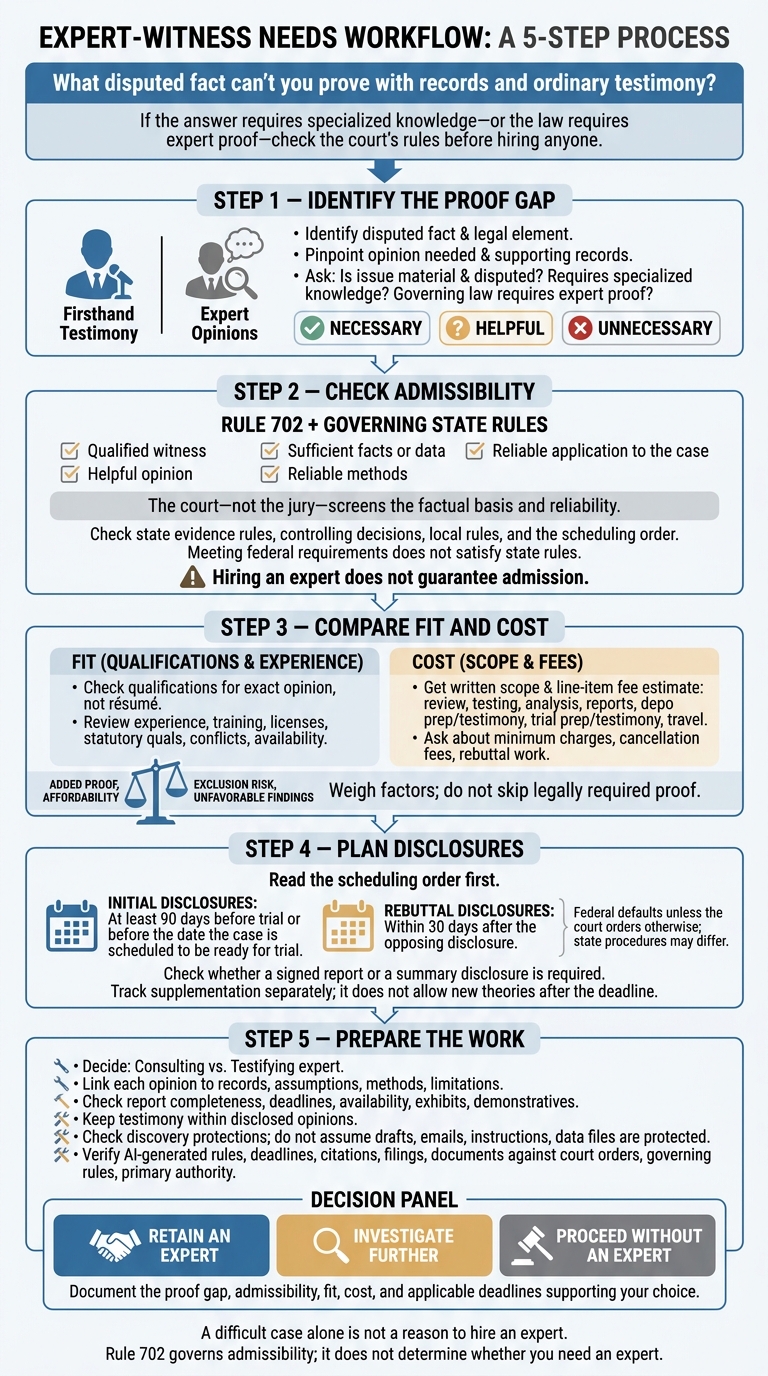
I start with one question: What disputed fact can’t you prove with records and ordinary testimony? If the answer requires specialized knowledge – or the law requires expert proof – check the court’s rules before hiring anyone.
Here’s the checklist I use:
- Identify the proof gap. Separate firsthand testimony from expert opinions.
- Check admissibility. Review qualifications, supporting data, methods, and state-law requirements.
- Compare fit and cost. Get a written scope and fee estimate for the exact opinion you need.
- Plan disclosures. Federal defaults generally allow 90 days before trial for initial disclosures and 30 days after the opposing disclosure for rebuttal, unless the court sets different deadlines.
- Prepare the work. Decide whether you need a consulting or testifying expert, organize records, and check discovery protections. Verify AI-generated rules and deadlines.
My goal is a documented choice: retain an expert, investigate further, or proceed without one. <u>A difficult case alone is not a reason to hire an expert.</u>
I spent six years representing myself in a personal injury case, and in a case that long, every dollar and every hour competes with every other. Knowing exactly which facts need expert proof, and which ones don’t, is how you protect both your case and your budget.
Expert Witness Needs: A Five-Step Decision Guide
The Role of an Expert Witness
Check Whether Expert Testimony Meets Rule 702
Hiring an expert does not guarantee admission. Under Rule 702, the party offering the testimony must show that the opinion will help the factfinder, rests on sufficient facts or data, uses reliable methods, applies those methods reliably, and comes from a qualified witness. The 2023 amendment confirms that the court – not the jury – screens the factual basis and reliability. When an issue appears to need expert testimony, check admissibility before investing time or money in the witness.
Review Helpfulness, Facts, and Methods
Check whether the opinion helps resolve a disputed issue and rests on sufficient facts, reliable methods, and a reliable application of those methods to the case. Request the records, measurements, assumptions, calculations, and reasoning behind each conclusion. Ask the expert to address contrary evidence and explain what could change the result. A recognized method cannot fix unsupported assumptions or unexplained leaps in reasoning. The judge serves as gatekeeper.
I learned how much the rules around testimony matter at a sanctions hearing in my own case. It wasn’t an evidentiary hearing, but the judge invited the mediator to speak anyway. He wasn’t sworn in, I had no chance to question him, and he had a financial stake in the outcome because he wanted to get paid. Because I had a court reporter, I objected on the record, and that objection gave me a strong issue for appeal. The gatekeeping rules only protect you if you hold the court to them.
Daubert factors may include testing, peer review and publication, known or potential error rates, standards and controls, and general acceptance. Not every expert must satisfy every factor. The inquiry depends on the field and the proposed opinion. Unsupported assertions, selective use of records, or conclusions that go beyond what the analysis supports can lead to exclusion or limits on testimony.
Use a Checklist to Assess Expert Needs
For each proposed opinion, use a Rule 702 checklist:
- Is the issue material and disputed?
- Does it require specialized knowledge?
- Does governing law require expert proof?
- Can a qualified witness support the opinion with sufficient data and reliable analysis?
Assess cost and practical value separately. An affordable opinion may be inadmissible, while an admissible opinion may add little to your case.
Check State-Court Rules
State rules may require or bar expert testimony even when federal analysis does not. States may follow a Daubert-style approach, a Frye-style general-acceptance test, or a statutory variation.
Check the state evidence code, controlling appellate decisions, local rules, and scheduling order. Review requirements and deadlines for qualifications, affidavits, disclosures, reports, depositions, and motions. Meeting federal requirements does not satisfy state rules.
Choose an Expert for the Issue and Budget
After Rule 702 screening, choose a witness who can fill the proof gap at a defensible cost. Define the assignment first: identify the disputed fact, the legal element it affects, the opinion needed, and the supporting records. Label the opinion necessary, helpful, or unnecessary. Hire an expert only when the opinion fills a real gap in the proof and is likely admissible.
Compare Expert and Nonexpert Proof
Use these examples alongside your issue-to-proof worksheet to connect each disputed fact with the evidence it needs.
Disputed issue Possible nonexpert evidence Expert discipline Expected opinion Admissibility risk Medical causation Treatment records Appropriately qualified physician Whether the injury or exposure probably caused the condition Incomplete history or ignored alternative causes Construction defects Photographs Structural engineer What caused the structural defect and what repair is needed Unsuitable methods Financial losses Ledgers Damages accountant Amount and cause of claimed losses Speculative projections Earning capacity Employment history Vocational expert Effect of established limitations on earning capacity Incomplete labor-market data Digital evidence Account logs Digital-forensics examiner Whether data was altered Unreliable tools Property valuation Comparable-sale records Real-estate appraiser Market value on a specified date Inappropriate comparables
Matching the issue to a discipline is only the first step. Next, check whether the witness can support the exact opinion you need.
Check Qualifications for the Specific Opinion
Look beyond the résumé. Check experience with the issue, relevant training, licenses, and statutory qualifications. Ask about conflicts, prior testimony, and availability for inspection, deposition, and trial. Request a written scope that specifies the records, deliverables, assumptions, and estimated hours.
Hypothetical qualification mismatch: A contractor with 20 years of experience building residential additions is asked to identify a design-calculation error in a post-tensioned concrete system. Before retaining that contractor for causation testimony, check experience with prestressed systems, structural calculations, and engineering standards. General construction experience alone may not support that opinion; a structural engineer with relevant experience may be better suited.
Weigh Costs, Benefits, and Risks
Once you confirm the fit, check the price. Get a written, line-item estimate for review, testing, analysis, reports, deposition preparation and testimony, trial preparation and testimony, and travel. Ask about minimum charges, cancellation fees, and rebuttal work.
Compare the cost with the value of the issue, but don’t skip required proof. Does the opinion add evidence that records and fact testimony alone can’t provide? Weigh the risks of exclusion, impeachment, and unfavorable findings. Give the expert complete records – not instructions aimed at a preferred outcome.
The hypothetical U.S. budgets below can help you assess affordability. They are not market quotes, and the risk labels describe possible weaknesses, not measured probabilities.
Issue importance Estimated expert expense Exclusion risk Testimony benefit Sufficiency of nonexpert evidence Central medical causation $15,000–$35,000 Medium to high with incomplete records or ignored alternative causes May establish causation and rebut opposing testimony Usually insufficient for disputed medical causation Structural failure in a $250,000 repair claim $18,000–$45,000 Medium with qualification or testing gaps May establish technical causation and reasonable repairs Often insufficient for technical causation $4,500 disputed debt payment $0–$3,000 Low for properly authenticated records Limited added value Often sufficient through bank records and testimony
Plan Expert Disclosures and Trial Preparation
Once you decide you need an expert, start checking disclosure rules and preparing for trial.
Check Report Requirements and Deadlines
Read the scheduling order first. Then review amendments, governing rules, local procedures, and stipulated deadlines. Under Federal Rule of Civil Procedure 26(a)(2), retained testifying experts and employees who regularly give expert testimony generally must submit signed reports. Other testifying experts generally need a disclosure summarizing the subject matter and expected facts and opinions. For treating providers, the opinions they offer – not their title – determine whether a report is required.
When a report is required, it should include all opinions and the reasons behind them, facts or data considered, supporting exhibits, qualifications, publications, prior testimony, and compensation. Unless the court orders otherwise, initial disclosures are due at least 90 days before trial or before the date the case is scheduled to be ready for trial. Rebuttal disclosures are generally due within 30 days after the opposing disclosure.
Track supplementation separately. Rule 26(e) does not allow new theories after the deadline. Late disclosures can lead to exclusion unless the delay has substantial justification or is harmless. State procedures may require different reports, summaries, or affidavits.
Once you confirm what the disclosure requires, connect each opinion to its supporting records and testimony.
Prepare Records, Opinions, and Testimony
Build a readiness checklist that links each disclosed opinion to the records, assumptions, methods, and limitations behind it. Include qualifications, report completeness, deadlines, deposition and trial availability, exhibits, and demonstratives.
Prepare the expert to explain how the source records support each conclusion and to address admissibility challenges. Keep testimony within the disclosed opinions, and do not ask the expert to reach the legal conclusion.
One more lesson that applies to every witness, including you. When you represent yourself, you are both the advocate and a fact witness. At one hearing in my case, opposing counsel asked me questions and I answered them. It was just two questions, but it was enough. Testimony belongs under oath, at an evidentiary hearing, within the scope you prepared for. That goes for your expert, and it goes for you.
Also decide whether the expert will serve as a consulting expert or testifying expert. Consulting experts generally help evaluate the case without testifying. Their work may receive discovery protection, with exceptions such as exceptional circumstances. Testifying experts face disclosure and deposition requirements.
Do not assume drafts, emails, instructions, or data files are protected. Federal protections have limits, and sharing consulting work with a testifying expert may expose that work to discovery.
Organize Expert Tasks With Courtroom5
Use Courtroom5 to organize expert issues, records, deadlines, questions, and task logs. Verify every AI-generated rule, deadline, citation, filing, and document against the court order, governing rules, and primary authority.
Treat the tool as an organizational aid – not a decision-maker on admissibility or a substitute for governing court rules, legal advice, or expert judgment.
Conclusion: Record Your Expert-Witness Decision
Use the worksheet to make the final call. Hiring an expert is a proof decision, not an automatic expense. Match each claim and defense to the proof you already have. Then identify any gap that expert testimony must fill. Rule 702 governs admissibility; it does not determine whether you need an expert.
If a gap remains, check whether the proposed expert fits the exact opinion you need, whether it concerns causation, damages, or another technical issue. Record the data, methods, assumptions, and limits behind that opinion. Credentials cannot replace missing data or reliable analysis.
Once you’ve confirmed the need and fit, price the work and document your decision. Get a written fee estimate. Weigh the cost against the proof the expert would add and the risk that the testimony could be excluded or limited. Complete the worksheet with supporting records and one of three decisions: retain, investigate further, or proceed without an expert. Verify disclosure deadlines before retaining the expert.
FAQs
What if I can’t afford a required expert?
If you can’t afford a required expert witness, focus on planning your case and managing your budget. Courtroom5’s AI-powered tools help people representing themselves prepare documents and work through case decisions with guidance.
Keep your case materials organized and track deadlines to develop a plan that fits your case and budget.
Can my treating doctor testify as my expert?
Yes, your treating doctor can testify in your case. In civil litigation, treating doctors often explain the care they provided, what they observed, and the medical facts of your treatment.
Before trial, work with your doctor to help keep their testimony clear, concise, and focused on your legal claims. Prepare them for the courtroom setting and the questions they may face during direct and cross-examination.
What if my expert reaches an unfavorable conclusion?
If your expert reaches an unfavorable conclusion, be ready to adjust your trial strategy as new evidence or witness testimony comes in. Review your case’s strengths and weaknesses, paying close attention to how the facts support each element of your claims or defenses. You may need to revise your evidence or approach while keeping your focus on winning the case.