
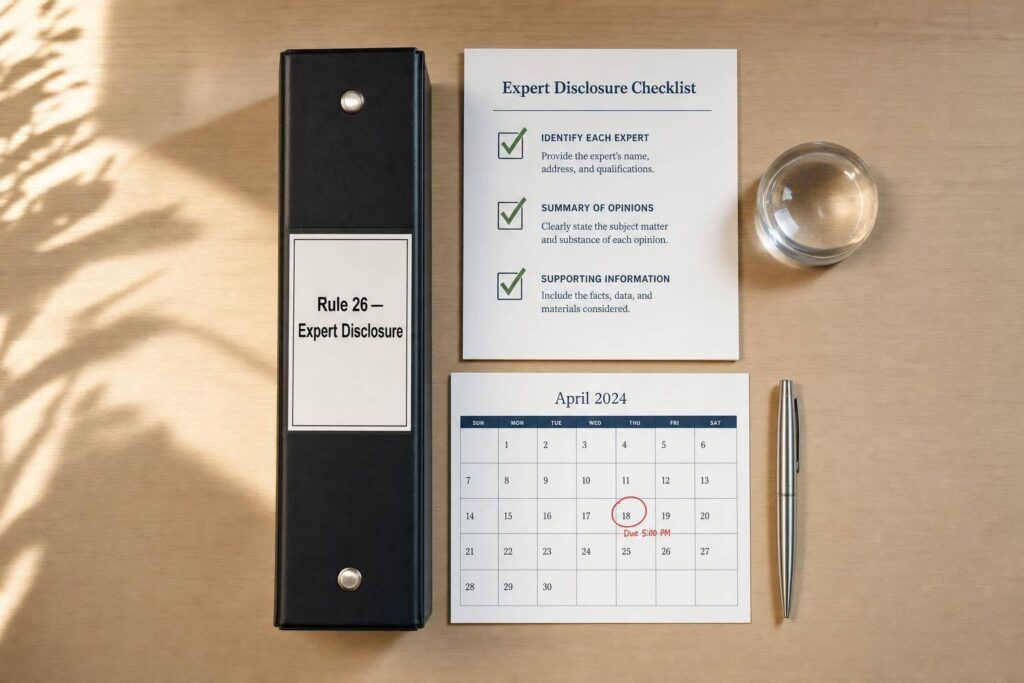
If you miss an expert disclosure deadline in federal court, your expert may be blocked from testifying. That is the main point of Rule 26, and Rule 37(c)(1) is the rule courts use to enforce it.
If I were reading this for a fast answer, here’s what I’d want up front:
- Rule 26(a)(2) says who I must disclose as an expert, what I must give the other side, and when I must do it.
- Retained experts usually need a written report with opinions, reasons, facts or data, exhibits, qualifications, publications, past testimony, and pay details.
- Non-retained experts usually need a shorter summary disclosure, not a full report.
- If the court does not set a different date, expert disclosures are usually due 90 days before trial, and rebuttal disclosures are due 30 days after the other side’s disclosure.
- Rule 26(e) means I must update a disclosure if it becomes materially incomplete or wrong.
- Rule 26(b)(4) protects draft reports and most attorney-expert communications, but some items still must be turned over.
- Courts can exclude expert testimony if disclosure rules are not followed. In federal practice, that can decide the case.
A few points matter more than anything else:
- Know which type of expert you have.
A hired expert and a treating doctor are not disclosed the same way. - Watch the schedule.
The court’s scheduling order controls in most cases. If I miss that date, I may lose the witness. - Match the expert to a claim or defense.
If the opinion does not help prove causation, standard of care, damages, or another issue in dispute, the expert may not help much. - Keep facts separate from lawyer communications.
Some things stay protected, but facts or data given to a testifying expert may still be discoverable.
Quick take: Rule 26 is less about fancy procedure and more about deadlines, complete disclosures, and clean expert files. If I get those three things right, I cut the risk of exclusion before trial.
That matches my experience, and I say this as someone whose doctorate is in library and information science. The hard part of a rule like this was never the impressive vocabulary. Res judicata, prejudice, affirmative defenses — I could look those up and understand them fine. It was the small words that stumped me. Does “must” mean must? Does “may” leave me room? Rule 26 is built out of small words like those, so read it slowly and literally, one requirement at a time.
Expert Disclosures | Explained Simply (Civil Procedure)
Rule 26(a)(2): What You Must Disclose and When
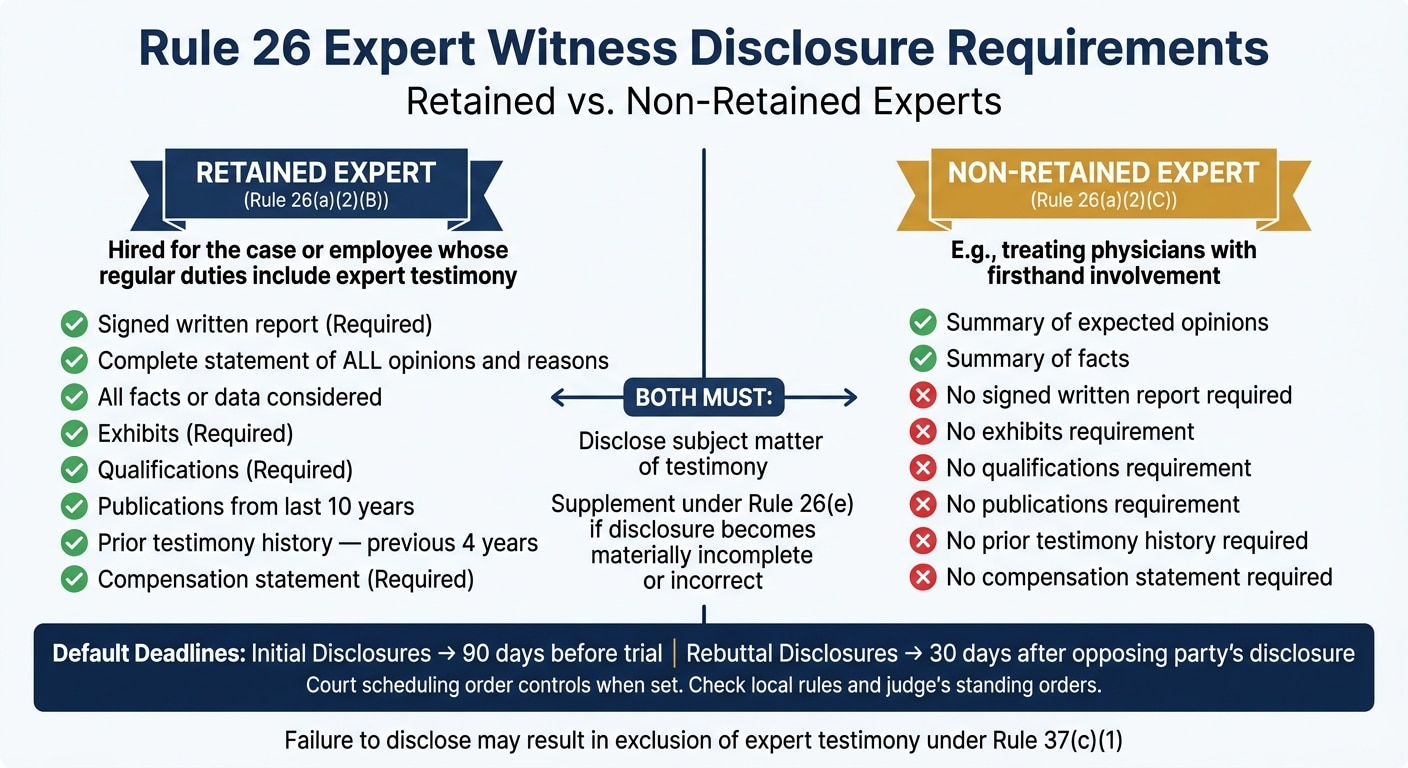
Rule 26 Expert Witness Disclosure Requirements: Retained vs. Non-Retained Experts
Rule 26(a)(2) boils down to three things: who you must disclose, what you must disclose, and when you must do it.
Timing usually comes from the scheduling order. If there is no scheduling order, initial expert disclosures are due 90 days before trial, and rebuttal disclosures are due 30 days after the other side’s disclosure. Once that date is in place, the next step is simple: figure out what each disclosure has to say.
“A party must make these disclosures at the times and in the sequence that the court orders.” – Federal Rule of Civil Procedure 26(a)(2)(D)
Identifying Every Expert You May Use at Trial
You need to disclose every witness you may call to give expert testimony at trial.
Written Reports Required for Retained or Specially Employed Experts
If the expert was hired for the case, or is an employee whose regular job duties include giving expert testimony, Rule 26(a)(2)(B) calls for a signed written report. That report must include:
- all opinions and the reasons for them
- the facts or data considered
- any exhibits
- qualifications
- recent publications
- prior testimony history
- compensation
Courts do not treat this as a box-checking exercise. In Moore v. International Paint L.L.C. (5th Cir. 2013), the Fifth Circuit upheld exclusion of an expert whose report gave only conclusory statements and did not include the reasoning Rule 26 calls for.
That said, not every expert has to provide this kind of report.
Summary Disclosures for Non-Retained Experts and the Duty to Supplement
Non-retained experts, such as treating physicians, do not need a Rule 26(a)(2)(B) report. Instead, the disclosure must state the subject matter and give a summary of the facts and opinions.
Even though this is a shorter disclosure, it still has to stay current as the case moves forward. A thin or stale disclosure can lead to a motion to strike or exclusion. Under Rule 26(e), you must supplement if you later learn that a disclosure is materially incomplete or incorrect. For retained experts, that duty applies to both the report and deposition testimony. Miss the deadline, and exclusion can follow unless the failure was substantially justified or harmless.
| Requirement | Retained Expert – Rule 26(a)(2)(B) | Non-Retained Expert – Rule 26(a)(2)(C) |
|---|---|---|
| Signed written report | Required | Not required |
| Statement of opinions | Complete statement of all opinions and reasons | Summary of expected opinions |
| Facts or data considered | All facts or data considered | Summary of facts |
| Exhibits | Required | Not explicitly required |
| Qualifications | Required | Not explicitly required |
| Publications | 10 years | Not explicitly required |
| Prior testimony history | Previous 4 years | Not required |
| Compensation statement | Required | Not required |
These disclosures also shape what the other side can later ask for in expert discovery.
Rule 26(b)(4): Discovery Limits, Work Product, and What the Other Side Can Access
Once disclosures are served, Rule 26(b)(4) sets the line for what the other side can ask for next. It does more than cover what an expert must disclose. It also sets limits on how far expert discovery can go after disclosure.
Testifying Experts vs. Non-Testifying Consulting Experts
The split here is pretty simple: testifying experts are open to discovery; consulting experts usually are not.
A consulting expert stays protected unless the other side can show exceptional circumstances. In plain English, that means they must show the same information can’t be obtained some other way.
Draft Reports and Attorney Communications After the 2010 Amendments
The 2010 amendments gave experts and lawyers more room to work without every draft becoming fair game. Rule 26 protects drafts of any required expert report or disclosure, no matter the format.
That includes:
- Handwritten notes
- Electronic drafts
- Documents with tracked changes
The rule also protects most communications between counsel and the expert. That includes discussions about legal theories and litigation strategy.
What Remains Discoverable Despite Those Protections
This is where people often get tripped up. Some materials stay protected, but some still have to be produced.
| Item Type | Status |
|---|---|
| Draft expert reports or disclosures | Protected |
| Most attorney-expert communications | Protected |
| Expert compensation details | Discoverable |
| Facts or data provided by counsel and considered by the expert | Discoverable |
| Assumptions provided by counsel and relied on by the expert | Discoverable |
| Consulting expert opinions | Generally protected, absent exceptional circumstances |
The line between facts or data and assumptions matters.
Facts or data are discoverable if the expert merely considered them. The expert does not need to rely on them for discovery to reach them.
Assumptions are narrower. They are discoverable only if the expert actually relied on them.
If you’re pro se, expect the other side to ask for factual materials you gave to a testifying expert. A good rule of thumb is to keep strategy separate from factual materials. If the expert considered something factual, it may end up in discovery.
Expect it, and decide in advance how you’ll respond. In my personal injury case, the court held a hearing that was not supposed to be evidentiary — and the judge invited the mediator to speak anyway, without swearing him in and without letting me question him. I objected on the record: this is not an evidentiary hearing, and I object to this witness because I’m not able to cross-examine him. The judge allowed it regardless. But my objection was in the record, and that is what preserved it. If something improper happens around a witness or an expert, say your objection out loud and specifically, even when you already know how the judge will rule.
For a pro se litigant, the next move is getting expert files in order so protected strategy and discoverable facts do not get mixed together.
How to Apply Rule 26 as a Pro Se Litigant
Knowing Rule 26 is one thing. Using it well as a pro se litigant is another.
The sections above explained what must be disclosed and what stays protected. Now the job becomes more practical: match the expert to an element you must prove, track the deadline, and keep your file organized.
Connect Each Expert Opinion to an Element You Must Prove
Start with the element you need to prove. Every claim has elements, and not all of them need expert support. But when a case turns on causation, the standard of care in a professional-liability dispute, damages calculations, or complex technical data, expert testimony may be required.
Federal Rule of Evidence 702 allows specialized knowledge only when it will help the jury understand the evidence or decide a fact at issue. The trial judge acts as the gatekeeper and decides whether the testimony is reliable enough to go to the jury. If jurors can follow the issue without specialized knowledge, you may not need an expert at all.
That’s the key filter before you spend money or time on one. Ask yourself: Which exact element of my claim or defense does this opinion support? If you can’t answer that in a plain sentence, pause and reassess. A non-retained witness should be used only for opinions tied to firsthand involvement, unless the witness must be disclosed as retained.
Build an Expert Disclosure Calendar from the Scheduling Order
Start with the scheduling order. Every expert deadline flows from that document. Put the scheduling-order deadline, rebuttal deadline, and supplementation deadline on one calendar so you can see the full timeline at a glance.
Also check the assigned judge’s standing orders and your district’s local rules. Some courts tie expert deadlines to the pretrial conference instead of the trial date. That can trip people up. Treat the pretrial deadline as your last internal check to make sure the disclosure is complete and any supplementation has been done.
Miss the disclosure deadline, or fail to supplement on time, and Rule 37(c) may keep that witness out of trial unless the failure was substantially justified or harmless. That’s a hard result, especially for a pro se litigant, so calendar control matters more than most people think.
I learned the deadline lesson from the receiving end. In my own case, the defendant sat on discovery I had requested for six months, then handed it over right before the sanctions hearing. I went ahead with the hearing anyway, and I made two mistakes: I hadn’t had time to actually review what they’d finally produced, and I walked in prepared to argue only one thing. When their attorney started asking me questions, I answered. It was two questions, and it was enough. Deadlines aren’t a formality — they decide who arrives prepared and who arrives improvising.
Organize Expert Documents and Reports Before Problems Arise
Once the deadlines are in place, organize the file as if opposing counsel will inspect every discoverable page. That mindset helps. Keep facts, drafts, and strategy in separate files so nothing gets mixed together.
Before filing, confirm that the report includes every Rule 26(a)(2)(B) item and every document the expert considered. A simple checklist can save you from a messy fix later.
For a non-retained expert, the disclosure is more limited. You need to identify the subject matter of the testimony and give a summary of the facts and opinions the witness is expected to testify about.
Conclusion: The Rule 26 Points That Matter Most Before Trial
The practical test is simple: disclose the right expert, in the right form, by the right deadline.
The type of disclosure determines what you have to file. A retained expert needs a signed report under Rule 26(a)(2)(B). A non-retained expert usually needs only a summary under Rule 26(a)(2)(C).
Once disclosure is done, the discovery limits matter just as much. Draft reports and most attorney-expert communications are protected. But some items are still discoverable, including:
- compensation
- facts or data the attorney provided and the expert considered
- assumptions the attorney provided and the expert relied on
The big takeaway is simple: Rule 37(c)(1) is unforgiving. If you miss a disclosure deadline or fail to supplement on time, the court can bar the expert from testifying at trial. Treat supplementation as an active duty, not an optional extra.
Here’s what I’d want you to take from all of this. Everything I know about Rule 26 I learned by getting it wrong first, in a case I carried by myself for six years. That hearing where I said too much felt small at the time, and in retrospect it was one of the most valuable things that happened to me — I used what I learned there to win something much bigger later. You are allowed to be new at this. Read the rule, mark the dates, keep the file clean, and let the mistakes teach you instead of stop you.
FAQs
Do I need an expert at all?
It depends on the proof you need for your case. Under Federal Rule of Civil Procedure 26, you must identify any witness you plan to use for expert testimony under Federal Rules of Evidence 702, 703, or 705.
If your case turns on specialized knowledge, like medical causation or technical analysis, expert testimony may be needed. By contrast, consulting experts who will not testify usually do not have to be disclosed.
How do I know if my witness is retained or non-retained?
Under Federal Rule of Civil Procedure 26, ask whether the witness’s expert opinions came from personal involvement in the facts of the case or whether those opinions were developed for the lawsuit.
A retained witness is usually hired to give expert testimony and had no prior connection to the events at issue. A non-retained witness, such as a treating physician or employee, forms opinions from firsthand knowledge gained before the lawsuit.
What happens if I miss the expert disclosure deadline?
Missing the expert witness disclosure deadline can cause serious problems. In some cases, the court may strike your expert or stop that expert from testifying at trial.
The same risk applies to rebuttal evidence. If you try to introduce new or independent opinions after the deadline by labeling them as rebuttal, the court may exclude that evidence as untimely.
That’s why scheduling deadlines matter so much. A court’s case schedule often controls the timing, even over Rule 26’s default deadlines, so those dates need close attention.