

Most U.S. civil cases settle before trial, and the style you use can shape the result. In this article, I break down four common styles – competitive, cooperative, integrative, and hybrid – so you can see when each one fits, where it can go wrong, and what to watch for if you’re negotiating on your own.
Here’s the short version:
- Competitive: push hard for the best deal for your side
- Cooperative: work toward a deal both sides can accept
- Integrative: trade across terms like money, timing, privacy, and release language
- Hybrid: stay firm on top issues, but move on lower-priority points
If you want the fastest takeaway, it’s this: there is no one right style. A single-issue money case may call for a hard line. A dispute with several moving parts may call for issue trading. And many cases end up using some mix of both.
A few points matter most:
- Leverage often drives style choice
- Information sharing changes how offers move
- Concessions can be early, late, steady, or tightly conditional
- Risk of deadlock is highest when both sides stay rigid
- Multi-term deals often open paths that a dollar-only fight will miss
About 95% to 97% of U.S. civil cases end without trial, so settlement style is not a side issue – it’s a core part of case strategy. If you’re pro se, that means you still need to sort out claim value, proof, weak spots, and terms you will or won’t accept.
Quick Comparison
| Style | Main Focus | How Concessions Happen | Best Fit | Main Risk |
|---|---|---|---|---|
| Competitive | Get the best outcome for your side | Small, late, conditional | Money disputes with strong leverage | Deadlock |
| Cooperative | Reach a workable deal | Steady, mutual movement | Cases where the relationship or cost matters | Giving up too much |
| Integrative | Trade across several terms | X for Y trades | Cases with many terms in play | Weak drafting or one-sided sharing |
| Hybrid | Hold firm on top issues, move on others | Selective, gradual | Cases with mixed pressure points | Mixed signals |
So if you’re asking, “Which style should I use?” my answer is simple: match the style to the case, the leverage, and the terms on the table. The rest of the article explains how each style works in plain English.
I’ve negotiated from both ends of that table without a lawyer, and the style I picked mattered a lot less than what I knew going in. Every settlement conversation I’ve been in turned on one question: does the other side think I understand my own case? When the answer was yes, the tone changed. When it was no, no amount of technique helped.
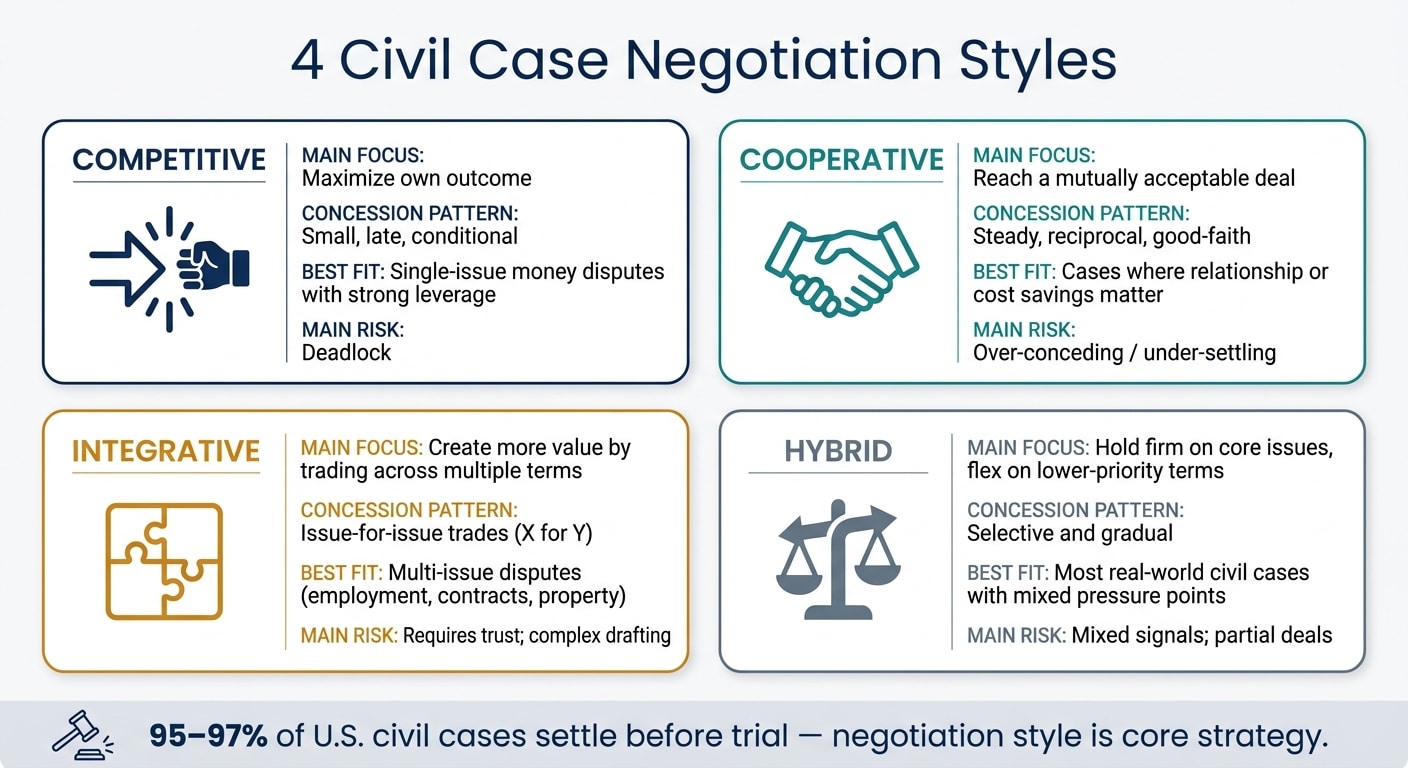
4 Civil Case Negotiation Styles: Quick Comparison Guide
The Art of Settlement: Techniques for Better Deals
1. Competitive Negotiation
Competitive negotiation treats a civil dispute like a zero-sum fight. One side’s gain is the other side’s loss. People keep information close to the vest, and leverage tends to run the conversation.
Primary goal
The aim is simple: get the best money or legal outcome possible. That usually means getting more money, paying less, or locking in better settlement terms.
In this style, negotiators often start with a hard anchor, press on deadlines, and use firm take-it-or-leave-it offers.
Concession pattern
Concessions usually come slowly. And they’re almost always conditional.
Each move tends to be small and tied to something in return, like dropping a claim or agreeing to confidentiality. Nobody gives ground for free.
Best case fit
This approach works best in money disputes, short-term relationships, and cases where one side has clear leverage. For example:
- Strong evidence
- Favorable precedent
- A looming hearing
When one party has that kind of edge, a hard-bargaining style can make sense.
Settlement risks
The biggest risk is impasse. Hard anchors and limited concessions can stall talks and push the case toward trial.
Overconfidence can also become a problem. A party may turn down a fair offer because they think they can do better. And when the focus stays locked on dollars, people can miss other terms that might help move the deal forward, like payment plans or non-monetary concessions.
If leverage is weaker, or the relationship matters more, another style is often a better fit.
I watched overconfidence lose a case in about ninety seconds. Our landlord flew in from Virginia with her brother for an eviction hearing. When my wife and I walked over to try to negotiate before it started, she looked at us, said “y’all are just too…” and snapped her fingers dismissively. Then the judge called the case, read the file, started shaking his head, and dismissed it before we ever stood up — the plaintiff hadn’t met the elements of an eviction. She had posture. We had a defense we’d gone and found. Posture is not leverage.
2. Cooperative Negotiation
Cooperative negotiation takes a collaborative approach. Instead of treating the other side like an opponent to beat, both parties work like partners trying to reach a settlement. Information tends to move more openly, and the focus stays on solving the problem together, not squeezing out leverage. This approach tends to work best when both sides care more about certainty than leverage.
Primary goal
The goal is a deal both sides can live with – not a one-sided win. Parties tend to center the discussion on shared interests, like cost control, certainty, and avoiding the unpredictability of trial. Offers are often tied to objective measures such as medical bills, wage loss, and comparable settlements. That helps keep the discussion rooted in facts instead of hard positions.
Concession pattern
Concessions usually happen earlier and at a steadier pace than in competitive negotiation. Each side expects movement to be met with movement. Offers often begin in a reasonable range, and each step is matched by a corresponding adjustment from the other side.
Best case fit
This makes cooperative negotiation a better fit than hard bargaining when settlement depends on keeping the conversation open. It works well in disputes where both sides want to preserve a relationship or cut trial costs, including many insurance, business, and landlord-tenant cases. It also fits mediation and court settlement conferences.
Settlement risks
The biggest risk is giving up too much, too soon. A party that wants to preserve goodwill may accept terms below what the case is actually worth. Sharing weak points can also backfire if the other side uses that information without making similar concessions. Power gaps matter here too. A well-resourced party can sound cooperative while quietly sticking to its own valuation.
Decide your floor before you walk in, and write it down. Years ago I had a tiny business in Atlanta with an answering service that was billing me around $500 a month for maybe two calls. I had the call-forwarding records, so I calculated what the service was actually worth, sent a check marked “payment in full,” and they cashed it — then sued me anyway. At mediation they brought three people, which I understood to be a message. I said one thing and kept saying it: I’ve already paid you everything I’m paying you. Having that number settled in advance is what made it possible to sit there and not move.
For pro se litigants, Courtroom5 can help test settlement ranges and organize reasoned offers.
The next style keeps some of this collaborative tone but adds more strategic pressure.
3. Integrative Negotiation
Building on cooperation, integrative negotiation adds deliberate issue trading. The focus is on needs, not positions. In civil cases, that usually means working across several terms at once – payment timing, confidentiality, future conduct, and related claims – instead of fighting over one dollar figure.
Primary goal
The goal is to create the most value for both sides by finding what each party wants beneath the demand. A plaintiff may care more about speed, certainty, or privacy than a bigger payout. A defendant may care more about avoiding a public admission of fault than the settlement amount itself.
Once those interests are out in the open, the path to a deal often gets wider. A court judgment might give money and little else. A negotiated deal can do more – like a lower payment paired with a non-disparagement clause and a faster payment schedule.
Concession pattern
Concessions are conditional: one side gives on X only if the other gives on Y. That issue-trading approach can work well. For example, one party might offer flexibility on payment timing in exchange for better terms somewhere else, or accept a confidentiality clause in exchange for dropping a related claim. This kind of trade can lead to better joint outcomes.
Best case fit
This approach works best when several terms are open for discussion. That often includes:
- Contract cases
- Employment disputes
- Partnership disputes
- Landlord-tenant matters
- Consumer cases
- Some personal injury claims
It helps less when one side won’t share basic information, has no room to move on terms, or is using negotiation mostly to stall litigation.
Settlement risks
The main risks are showing priorities too soon, fake cooperation, and vague drafting. Settlement terms should spell out payment dates, deadlines, release language, and default terms with care. If parties mix issue trading with harder pressure, the style starts to shift into hybrid negotiation.
4. Hybrid Negotiation
Hybrid negotiation blends hard bargaining with issue-based problem-solving. In plain English, you push where you need to push and work things out where there’s room to move. The approach shifts based on the facts of the case and how the other side responds. It sits between competitive pressure and cooperative problem-solving, which makes it useful when a dispute has one or two tough sticking points but still leaves space to trade on everything else.
Primary goal
Protect the issues that matter most while staying flexible on lower-priority terms, such as timing, confidentiality language, or dismissal terms.
Concession pattern
Concessions here are selective and gradual. One side may give a few small, low-cost points early to get talks moving, then stay firm on the issues that matter most until the other side gives something back.
For example, a defendant may agree to faster mediation scheduling or revised release language while refusing to increase the total payout. A plaintiff may lower a demand only after getting stronger assurances on payment structure or a neutral reference statement.
The basic idea is simple: concede small points early, then trade them for value on the terms that matter most.
Best case fit
This style works well in:
- Contract disputes
- Employment disputes
- Insurance disputes
- Landlord-tenant disputes
- Small business disputes
Settlement risks
The main risk is inconsistency. If your tone keeps switching too much, the other side may get mixed signals. There’s also a risk of reaching agreement on side issues while the main dispute stays open, which can drag out or complicate final settlement.
For pro se litigants, this style is harder to manage. Tools like Courtroom5 can help pro se litigants organize facts, assess leverage, and prepare settlement positions. That balance is what the comparison section measures next.
How the 4 Styles Compare
The table below stacks up the four styles across leverage, information sharing, and settlement structure.
| Negotiation Style | Primary Goal | Concession Pattern | Best Case Fit | Key Settlement Risks | Common Use in Mediation / Settlement Conferences |
|---|---|---|---|---|---|
| Competitive | Maximize own outcome | High/low anchors; small, guarded, tactical concessions made late | Single-issue, money-focused disputes with clear liability | Deadlock, distrust, brinkmanship; may frustrate judges or mediators | The money-focused bargaining phase |
| Cooperative | Reach a fair, mutually acceptable settlement | Moderate opening positions; steady, reciprocal, good-faith concessions | Disputes where preserving a relationship or reducing hostility matters | Can be exploited by harder bargainers; risk of under-settlement | When parties want closure and reduced conflict |
| Integrative | Create more value for both sides | Issue trading across money and non-monetary terms; package-based | Multi-issue commercial, employment, or property disputes with room for tradeoffs | Requires trust and information sharing; complex agreements can be harder to enforce | Mediation’s problem-solving stage; mediators test interests in private meetings |
| Hybrid | Secure a solid baseline while staying flexible on lower-priority terms | Competitive on core issues; integrative or cooperative on secondary terms | Most real-world civil cases, especially settlement conferences with mixed risk | Inconsistent signals can create mistrust; partial deals may leave value unclaimed | Very common in practice; combines the other three styles as the case develops |
In practice, civil mediators often shift between problem-solving and dollar-focused bargaining. That back-and-forth looks a lot like the hybrid style, more than any single approach.
Pros and Cons of Each Negotiation Style
Every negotiation style comes with tradeoffs. What works best usually depends on three things: leverage, the relationship between the parties, and the value of the case. The table below lays out the main day-to-day tradeoffs in a simple way.
| Negotiation Style | Major Pros | Major Cons | Strongest Use Scenario |
|---|---|---|---|
| Competitive | Can produce favorable monetary outcomes when leverage is strong; helps reduce the risk of being pushed around by an aggressive opponent | Greater deadlock risk; can damage trust and make later cooperation harder; settlements may feel coerced | Clear-liability, single-issue money disputes. |
| Cooperative | Reaches agreement faster; preserves relationships; parties are more likely to feel satisfied with the process | Can lead to under-settling or over-conceding, especially when the other side bargains hard | Disputes between parties who must keep dealing with each other. |
| Integrative | Tends to produce more durable settlements; addresses underlying interests; can reduce later conflict and enforcement problems | Slower at the start; requires trust and information-sharing; less effective in purely monetary, single-issue disputes | Multi-issue disputes with room to trade terms. |
| Hybrid | Flexible; lets you protect core leverage while still creating room for creative solutions; lowers deadlock risk compared with purely competitive bargaining | Can send mixed signals if the shift in tone is abrupt; requires skill to manage timing and client expectations | Mid- to high-stakes cases where legal rights and practical realities both matter. |
In practice, two issues tend to matter most: speed and relationship impact.
Cooperative and hybrid approaches often get to a resolution faster than purely competitive bargaining. That matters when delay costs money, energy, or both. A drawn-out fight might feel strong in the moment, but it can also burn time and narrow the path to settlement.
Competitive tactics have a different downside. They can weaken trust and make post-settlement cooperation harder. That’s a big problem when the parties still have to deal with each other after the case ends. Think business partners, neighbors, employers, or co-parents. In those situations, getting the deal done is only part of the job. Living with the aftermath matters too.
Guard against over-cooperation by deciding in advance which concessions are acceptable and which are off-limits. That way, you stay flexible without accepting an insufficient settlement just to get it done.
Conclusion
No single negotiation style fits every civil case. The best choice depends on leverage, goals, the posture of the case, and whether the parties need to keep working with each other. The practical rule is simple: match the style to the dispute, not the other way around.
Competitive, cooperative, integrative, and hybrid styles each fit different settlement pressures. But none is the best fit in every dispute.
What matters most is matching your style to the moment. As leverage shifts, your negotiation style should shift too. That’s why being able to change course matters.
One more thing about leverage, because it isn’t only about money or evidence. In that answering service case, what actually ended it was research. I found the doctrine of accord and satisfaction — they had cashed my check marked “payment in full,” which meant they couldn’t come back for more — and I filed a motion to dismiss citing the case law. While I argued it, the young court clerk sitting below the judge had his mouth wide open the whole time, like I was some kind of unicorn. Weeks later the judge dismissed the claim. Knowing the rule is leverage, and it’s the kind you can build yourself, for free, before you ever sit down at the table.
A rigid approach can hurt settlement. Competitive tactics can lock parties into hard positions. Cooperative tactics can give up too much. Integrative talks can fall apart when there’s no good faith. In many cases, the ability to adjust is what makes settlement possible.
For self-represented litigants, Courtroom5 can help organize claims and get ready for settlement talks.
FAQs
How do I choose the right negotiation style?
Start by getting clear on your target outcome and your bargaining limits before the conversation begins. Then look hard at the case from both sides: your strengths, your weak spots, the leverage you have, and the tactics that match your broader litigation strategy.
It also helps to practice your main talking points and possible offers with someone you trust. A quick run-through can make you feel steadier and more prepared once the negotiation starts.
Can I switch styles during settlement talks?
Yes. You can change your negotiation strategy during settlement talks so it lines up better with your goals.
The parties control the process, which means you’re not locked into your first plan. As talks move forward, you may learn new facts, get a better read on your leverage, or need to react to the other side’s tactics. If your first approach isn’t getting results, or new information changes what your case is worth, it can make sense to pivot.
What should I do if the other side will not negotiate in good faith?
If the other party won’t negotiate in good faith, you can shift to litigation. You do not have to settle. That means you can keep moving through discovery, motions, and trial.
You can also use civil procedure to put pressure on the other side by increasing their litigation costs or forcing them to deal with added demands in the case. When talks stall, Courtroom5 offers AI-powered tools for case management and legal research to help you work through those next steps.