
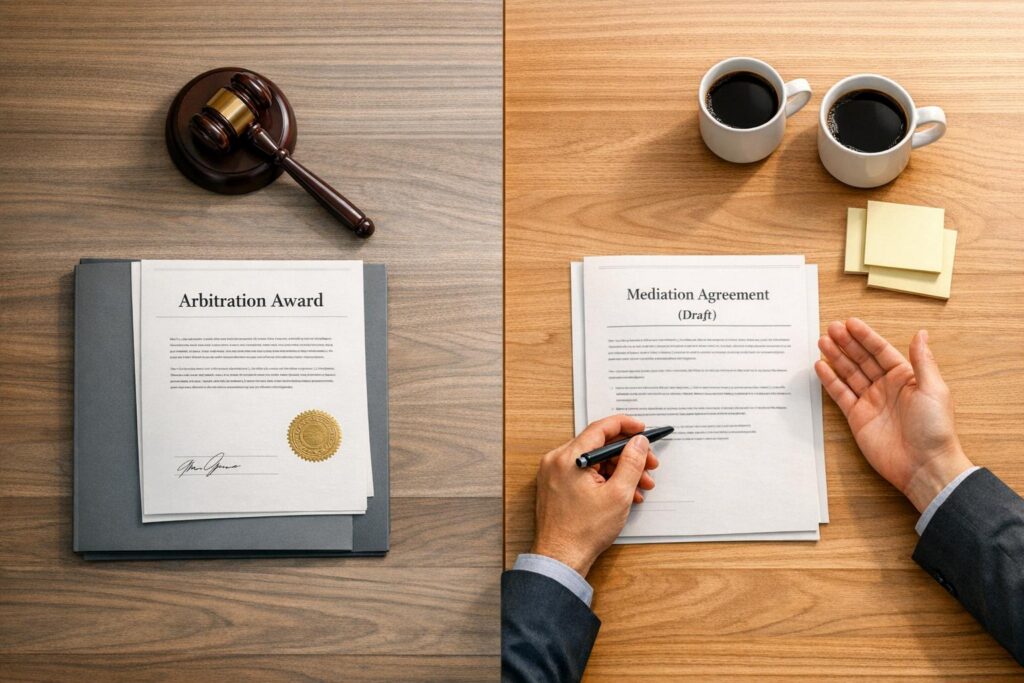
When resolving disputes, you don’t always need to go to court. Two common options – arbitration and mediation – offer quicker, less expensive alternatives. The key difference? Control. Arbitration involves a neutral arbitrator making a binding decision, while mediation lets both parties negotiate their own agreement.
Key Points:
- Arbitration: A neutral arbitrator decides the case, and the outcome is legally binding. It’s more formal and similar to a private trial.
- Mediation: A mediator facilitates discussions, but the parties control the outcome. It’s informal and focuses on collaboration.
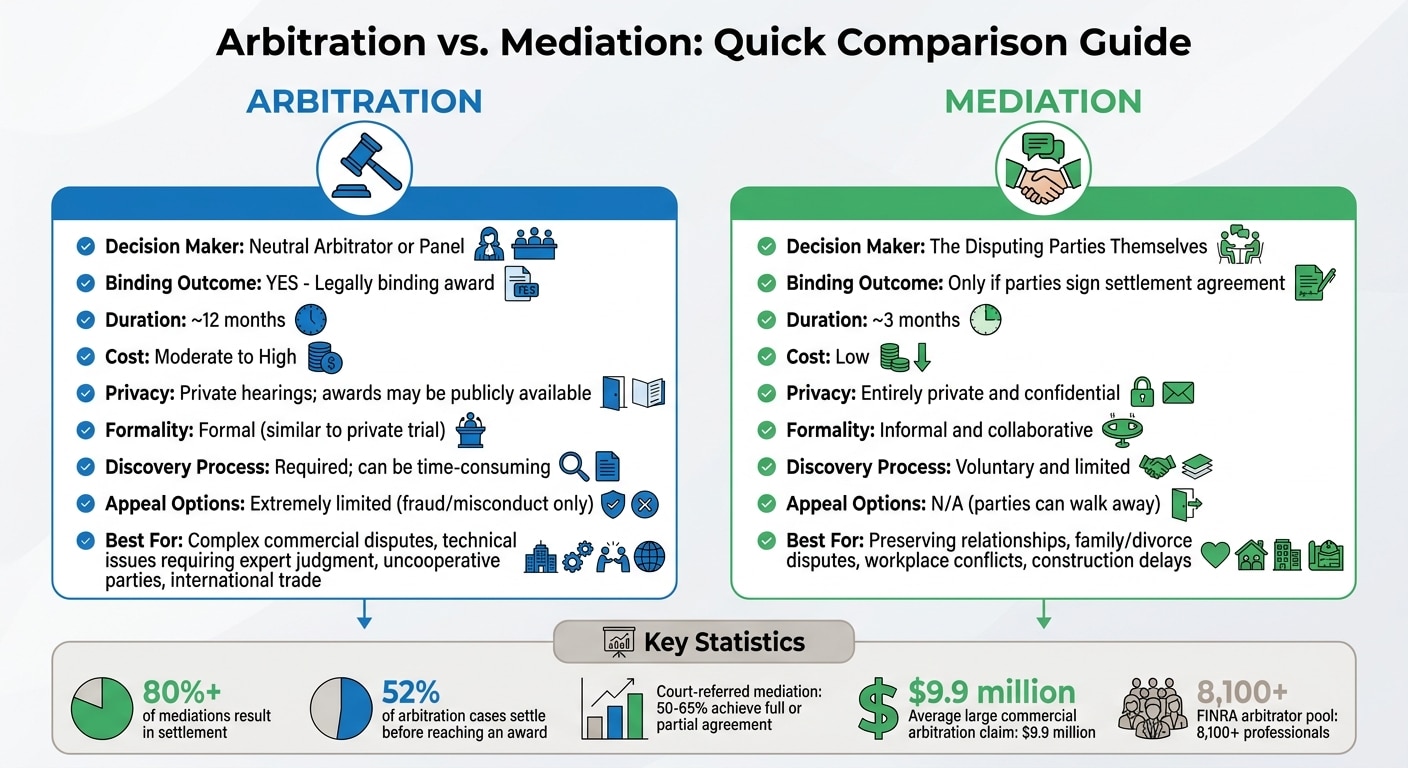
- Time and Cost: Mediation is faster (about 3 months) and cheaper. Arbitration takes longer (about 12 months) and costs more.
- Privacy: Both processes are private, but arbitration decisions may be publicly accessible in some cases.
Quick Comparison:
| Feature | Arbitration | Mediation |
|---|---|---|
| Decision Maker | Arbitrator | Disputing Parties |
| Binding Outcome | Yes | Only if parties agree |
| Duration | ~12 months | ~3 months |
| Cost | Moderate to High | Low |
| Privacy | Private but awards may be public | Fully private |
Choose arbitration for binding resolutions or technical disputes. Opt for mediation to preserve relationships or when collaboration is possible.
I’d add one caution before you choose. People often assume mediation is the gentler option — lower stakes, less formality, less risk. In my own case, mediation is where some of the worst damage happened to me, and not because the process is bad. It happened because I walked in treating it as informal, and everyone else in that room was still litigating.
Arbitration vs Mediation: Key Differences in Cost, Time, and Process
Arbitration or Mediation: What’s the Difference and How Do They Work?
What Are Arbitration and Mediation Agreements?
Arbitration and mediation agreements are contracts that outline how disputes will be resolved without going to court. Under the Federal Arbitration Act, written arbitration agreements are considered “valid, irrevocable, and enforceable,” giving them legal standing throughout the United States.
What Is an Arbitration Agreement?
An arbitration agreement commits the involved parties to an alternative dispute resolution process. In this process, a neutral arbitrator (or panel) reviews evidence, listens to arguments, and issues a legally binding decision called an “award.”
The setup resembles a trial but is more streamlined. Discovery is simplified, scheduling is more flexible, and the rules of evidence are less strict. You’ll still present witnesses and argue your case, but you also have the chance to choose an arbitrator with expertise specific to your dispute. For example, FINRA offers a pool of over 8,100 arbitrators from various professional fields.
“Arbitration is similar to going to court, but more efficient, cost effective, and less complex than litigation.” – FINRA
Once the arbitrator makes a decision, appeals are extremely limited – only possible in cases involving fraud or misconduct. This finality ensures a clear resolution without the risk of drawn-out appeals.
What Is a Mediation Agreement?
A mediation agreement takes a completely different route. Instead of imposing a decision, a neutral mediator helps the disputing parties communicate and negotiate a solution themselves. The mediator doesn’t have the authority to decide the outcome – they simply guide the discussion.
This process is informal and focuses on collaboration. It usually begins with an opening session to set the ground rules, followed by joint discussions and private meetings (called caucuses). In these private sessions, the mediator works through proposals and interests. If the parties reach an agreement, it’s recorded in a written settlement that everyone signs.
“The mediator holds no adjudicative authority; any settlement reached is the product of the parties’ own agreement.” – Mediation Authority
Mediation only works if both sides agree to the resolution. This makes it especially useful in situations where maintaining a relationship is important, such as between business partners or co-parents. The focus here isn’t about winning or losing – it’s about finding common ground.
With these two processes defined, it becomes easier to see how they differ in terms of control and structure.
Main Differences Between Arbitration and Mediation
The table below highlights the key differences between arbitration and mediation:
| Feature | Arbitration | Mediation |
|---|---|---|
| Decision Maker | Neutral arbitrator or panel | The parties themselves |
| Outcome Control | Arbitrator decides | Parties retain full control |
| Binding Nature | Yes – legally binding award | Only if parties sign a settlement |
| Formality | Formal, similar to a private trial | Informal and collaborative |
| Enforceability | Can be confirmed as a court judgment | Enforced as an ordinary contract |
Many commercial contracts include “step” provisions, requiring mediation before arbitration. This acknowledges that mediation can often resolve disputes faster and at a lower cost when parties are willing to negotiate. Interestingly, about 52% of business-to-business arbitration cases in 2025 were settled before reaching an award, showing that even arbitration-focused disputes often find resolution through discussion.
These core differences highlight how decision-making authority and enforceability vary between the two methods. Up next, we’ll dive into how these distinctions influence costs, privacy, and other key factors.
Decision-Making and Binding Outcomes
The key difference between arbitration and mediation lies in who decides the outcome and whether that decision is legally enforceable.
Arbitration: Binding Decisions
In arbitration, the arbitrator evaluates the evidence, listens to arguments, and delivers a final decision called an “award.” This award is legally binding, meaning both parties are obligated to comply, regardless of their preferences.
“Arbitration results in a binding final award. Once an arbitrator forms a decision, it will have the same effect as a court judgement.” – West Coast Trial Lawyers
Once issued, this award carries the same weight as a court judgment. Appeals are rare and only allowed in exceptional cases, such as fraud, clear bias, or misconduct. If the losing party refuses to comply, the winning party can take the award to court for enforcement. At that stage, the court can mandate payments or actions, just as it would with any other judgment.
In contrast, mediation does not impose a decision, leaving control entirely with the parties involved.
Mediation: Party-Controlled Outcomes
Mediation operates differently, as it puts the resolution process squarely in the hands of the disputing parties. The mediator has no authority to make binding decisions. Instead, their role is to guide discussions and help both sides reach a mutually acceptable agreement. You maintain full control over whether to settle and on what terms.
“A mediator may not impose his own judgment on the issues for that of the parties.” – Texas Civil Practice and Remedies Code
Because mediation is voluntary, you can choose to leave the process if the proposed solution doesn’t meet your expectations. Even if mediation fails, you still have the option to pursue litigation or arbitration.
A mediation agreement only becomes binding once both parties sign a written settlement. After signing, this agreement is treated like any other contract, and courts can enforce it. If someone breaches the terms, sanctions, costs, or attorney’s fees may be imposed.
Agreeing to mediate also creates obligations, and they are enforceable. In my personal injury case, all three defense attorneys filed a motion for sanctions against me claiming I had failed to appear at mediation. Whatever you agree to — the date, the location, who has to be present, whether you can attend remotely — get it in writing and keep proof that you complied. A scheduling misunderstanding in mediation can turn into a sanctions motion faster than you would believe.
Comparison Table: Authority and Enforceability
Here’s a quick breakdown of the differences:
| Feature | Arbitration | Mediation |
|---|---|---|
| Decision Maker | Neutral Arbitrator or Panel | The Disputing Parties |
| Role of Third Party | Issues a binding decision | Facilitates communication and settlement |
| Binding Status | Legally binding by default | Non-binding unless a written agreement is signed |
| Enforcement | Enforceable as a court judgment | Enforceable as a written contract |
| Appeal Options | Limited to specific grounds | N/A (Parties can walk away if no agreement) |
Understanding who controls the outcome and how binding each process is can help you choose the right path for resolving your dispute.
Cost, Time, and Privacy Considerations
When deciding between arbitration and mediation, practical factors like cost, time, and privacy play a crucial role in shaping the choice.
Cost and Time Requirements
Mediation is often the most affordable method and tends to resolve disputes much faster than arbitration. Most mediations wrap up within about three months, with over 80% leading to a settlement. The informal nature of mediation – featuring voluntary discovery and fewer formalities – helps keep expenses low.
Arbitration, while generally less costly than going to court, is more expensive than mediation. A typical arbitration case lasts about 12 months. Costs can add up due to arbitrator fees (especially for seasoned professionals), administrative charges, and attorney fees. Employers in employment disputes are often obligated to cover the arbitrator’s fees entirely. Additionally, non-binding arbitration can lead to “double costs” if the matter remains unresolved and proceeds to court.
“It may take several years to procure a court trial date, while an arbitration date can usually be obtained within a few months.” – SAC Attorneys LLP
For smaller disputes involving claims up to $50,000, simplified arbitration – relying mainly on written submissions without a hearing – can help reduce both time and costs.
Confidentiality and Privacy
Both arbitration and mediation offer more privacy than public court trials, where proceedings and records are typically open to the public. Mediation is entirely private, with no public record of discussions or settlements unless the parties choose to disclose them. Since mediation is a voluntary process, all details stay between the involved parties.
Arbitration also occurs in private settings, but the final awards may be published depending on the forum. For example, FINRA makes arbitration awards publicly accessible online. If maintaining full confidentiality is critical, especially for sensitive matters, a confidentiality clause can be added to the arbitration agreement to safeguard the resolution’s details.
These differences in cost, time, and privacy are key in deciding which alternative dispute resolution (ADR) method aligns best with your needs.
Comparison Table: Cost, Time, and Privacy
| Feature | Arbitration | Mediation |
|---|---|---|
| Typical Duration | Approximately 12 months | Approximately 3 months |
| Relative Cost | Moderate to high; less than court but more than mediation | Lowest cost option |
| Privacy Level | Private hearings; awards may be publicly available | Entirely private and confidential |
| Discovery Process | Required; can be time-consuming and expensive | Voluntary and limited |
| Outcome | Final binding decision issued | Over 80% of cases result in settlement |
When to Use Arbitration vs. Mediation
Deciding between arbitration and mediation depends on what you want to achieve, the nature of the relationship between the parties, and the type of conflict involved. Each method has its strengths, and knowing when to opt for one over the other can save time, money, and unnecessary stress.
When Arbitration Works Best
Arbitration is a strong option when you need a binding decision to settle a dispute. It’s particularly effective when communication has completely broken down, and the parties are in direct opposition. Arbitration is especially suited for handling complex matters or technical issues that require expert input.
For example, in 2025, the American Arbitration Association reported that the average claim for large-scale, complex commercial arbitration was about $9.9 million. High-stakes cases like these often require arbitrators with specialized knowledge, which is especially critical in international trade disputes where neutral and expert judgment is needed for resolving multi-jurisdictional conflicts.
Arbitration is ideal when the parties are unlikely to collaborate, when technical expertise is essential, or when a definitive “winner” and “loser” outcome is needed to move forward. On the other hand, if maintaining a relationship or reaching a mutual agreement is more important, mediation might be the better route.
When Mediation Works Best
Mediation shines when the goal is to preserve relationships. Whether you’re working through a conflict with a business partner, a family member, or someone you’ll need to interact with in the future, mediation’s collaborative nature encourages open communication and creative problem-solving.
“The best outcomes tend to be generated by those involved.” – Venn Mediation
This method is particularly effective for family-related disputes like divorce or custody arrangements, workplace disagreements, and issues such as construction delays where quick resolutions are vital. It’s also useful in personal injury cases, offering a space for emotional resolution outside the rigidity of a courtroom. In court-referred mediation programs, about 50% to 65% of cases achieve a full or partial agreement.
If you want more control over the outcome, aim to cut costs, or need a faster resolution – often within weeks – mediation is likely the better choice. It’s also a great first step in cases where there’s a power imbalance, such as a small business negotiating with a larger corporation. Mediation can help balance the situation before moving to arbitration, if needed.
One thing nobody told me: the mediator is not necessarily neutral. In my case the mediator had a direct financial interest — he wanted to get paid — and when the court later held a hearing touching on that mediation, the judge invited him to speak without swearing him in and without letting me question him. I objected on the record. The judge allowed it anyway. Go into mediation knowing who is being paid by whom, and don’t assume the person in the middle has no stake in how it ends.
Dispute Type Comparison Table
Here’s a quick reference to help you decide which method suits different types of disputes:
| Dispute Type | Recommended Method | Primary Reason |
|---|---|---|
| Complex Commercial/Contracts | Arbitration | Requires expert judgment and a final, binding decision |
| Family/Divorce/Custody | Mediation | Preserves relationships and allows tailored agreements |
| Securities/Financial | Arbitration | Best for industry-specific claims with formal processes |
| Workplace/Employment | Mediation | Resolves conflicts while maintaining confidentiality |
| Construction Delays | Mediation | Promotes quick resolutions to keep projects on track |
| Personal Injury | Mediation | Provides space for emotional resolution outside of court |
| International Trade | Arbitration | Neutral forum for resolving multi-jurisdictional issues |
This table offers a practical way to match the dispute type with the most effective resolution method, helping you make informed decisions.
Conclusion
Deciding between arbitration and mediation hinges on the specific needs of your dispute. Mediation offers more control over the outcome, is less expensive, and often resolves disputes within about three months, boasting a high success rate. On the other hand, arbitration delivers a binding decision from an expert but typically takes around 12 months and involves higher costs due to formal discovery and hearings. It’s a better fit when the opposing party is uncooperative, technical expertise is required, or a definitive resolution is necessary.
“The low-risk, relatively low-cost nature of mediation makes it the ‘go-to’ dispute-resolution process.” – Program on Negotiation at Harvard Law School
For individuals representing themselves, both options have clear benefits. Mediation is often less intimidating as it focuses on collaborative problem-solving rather than rigid legal procedures. If arbitration is needed, streamlined options are available for smaller claims.
By understanding the differences in control, cost, and timeline, you can choose the approach that best aligns with your situation. Think about your relationship with the other party, how quickly you need resolution, whether expert input is required, and how much control you want over the process. A well-informed decision can safeguard your interests while saving time and money.
Here’s the part I hold onto. That hearing went badly, but because I had a court reporter present and because I put my objection on the record, I walked out with something valuable: an extremely strong appeal. My main point is this — if something improper happens to you in one of these processes, make sure your objection is in the record. If it isn’t, you lose the chance to do anything about it later. Whichever route you choose, go in documenting everything. That habit is what turns a bad day into a preserved issue.
For more support in navigating these options, pro se litigants can explore resources provided by Courtroom5 (https://courtroom5.com).
FAQs
Can I refuse arbitration or mediation if my contract requires it?
If your contract includes clauses for arbitration or mediation, you’re usually bound to follow them unless the agreement specifically provides an opt-out option – something that’s not common. Courts tend to uphold these clauses as legally binding. Make sure to read your contract thoroughly to understand what’s required of you, and seek advice from a legal expert if you’re unsure.
What happens if mediation fails to resolve the dispute?
If mediation doesn’t lead to a resolution, the next steps could involve arbitration or litigation. Mediation is a non-binding process, relying entirely on the willingness of both parties to agree. When that mutual agreement isn’t achieved, turning to other methods of dispute resolution may become necessary.
How do I make sure an arbitration award stays confidential?
To keep an arbitration award confidential, it’s crucial to include a well-defined confidentiality agreement in your arbitration terms. Courts have determined that merely agreeing to confidentiality for the proceedings doesn’t automatically extend to the award itself. To safeguard confidentiality, you may need to implement additional legal or procedural steps. Addressing this issue clearly during the arbitration process is essential.