
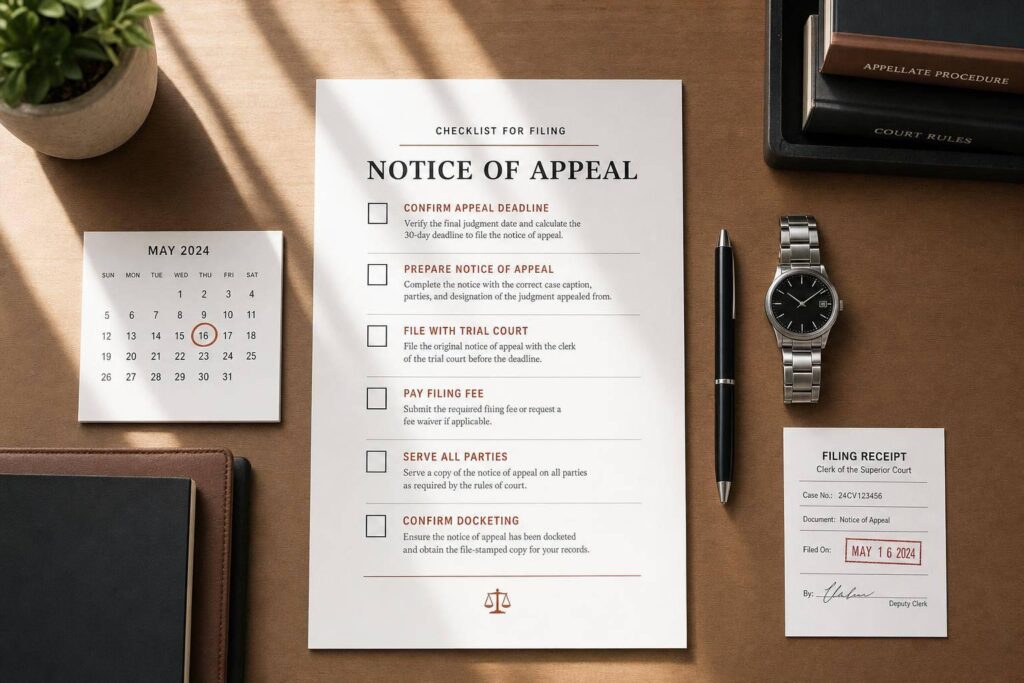
Miss the deadline by even 1 day, and your appeal may be over. In most federal civil cases, I have 30 days to file a notice of appeal after the judgment is entered on the docket, or 60 days if the United States or a federal agency or officer is a party.
Here’s the short version:
- I start with the docket entry date, not the hearing date
- I check for post-judgment motions that may reset the clock
- I file the notice in the district court, not the court of appeals
- I pay the $605 fee or file for a fee waiver
- I serve the other parties and save proof of filing
The main point: I need the right date, the right court, and proof that the filing went through on time.
A few facts matter most:
- In federal civil cases, the usual deadline is 30 calendar days
- Some motions, if filed on time, can change that deadline
- If I did not get notice of the judgment, reopening may be possible, but the time limits are tight
- E-filing logs and file-stamped copies can help show the notice was filed on time
If I were turning this into my own action list, it would be:
- Find the judgment or appealable order on the docket
- Count the last filing day
- Check whether any post-judgment motion changed it
- File the notice of appeal with the district court
- Serve all parties
- Save the receipt, NEF, or stamped copy
- Put every next deadline on my calendar
This article is a plain-English guide for that process, with a close look at deadlines, tolling motions, extensions, reopening, filing steps, and follow-up tracking.
I’ve been on the wrong end of a judgment with a clock already running. We lost an eviction case in Georgia — walked out with an eviction order and a $3,000 judgment against us — and the only reason that wasn’t the end of the story is that we got the notice of appeal in on time. Nobody hands you that deadline. You have to go find it.
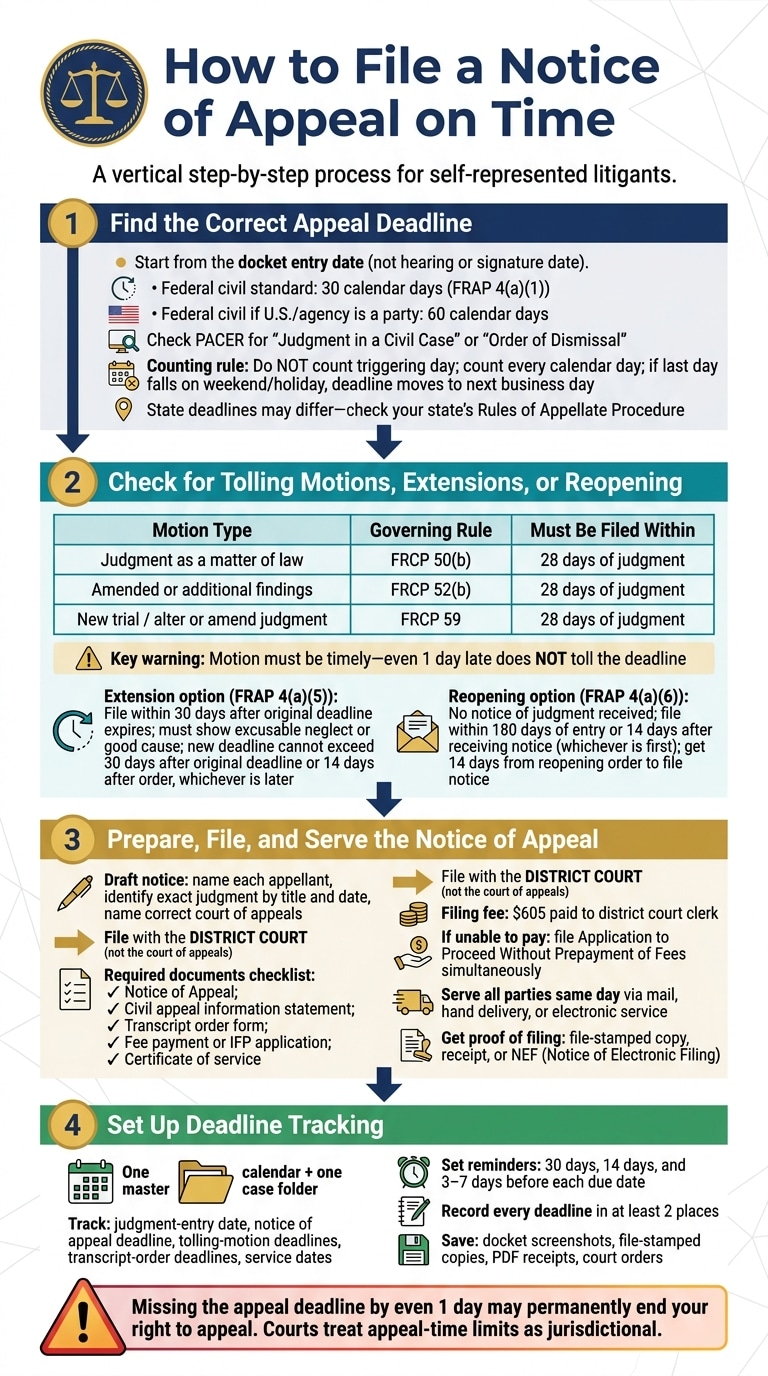
How to File a Notice of Appeal on Time: Step-by-Step Checklist
How Long To File Notice Of Appeal In Federal Court?
Checklist 1: Find the Correct Appeal Deadline
First, pin down the exact deadline. Everything else depends on that date.
Federal Civil Deadlines Under FRAP 4
Under Federal Rule of Appellate Procedure 4(a)(1), the standard deadline for a federal civil appeal is 30 days after the judgment or appealable order is entered on the district court docket. The deadline becomes 60 days if the United States, a federal agency, or a federal officer sued in an official capacity is a party to the case.
The key point is simple: the clock starts from the docket entry date. Not the hearing date. Not the date on the judge’s signature line.
Go into PACER and pull up the case docket. Look for an entry such as “Judgment in a Civil Case”, “Order of Dismissal,” or something close to that. Then note the “Filed” or “Entered” date listed on that docket entry. That is your trigger date.
Practical example: If the docket shows “Judgment in a Civil Case” entered on 05/10/2026, the appeal period runs from 05/10/2026 – even if the hearing occurred on 05/03/2026 or the written order is dated 05/09/2026.
State deadlines don’t follow the same setup, so the next step is to check the rule for your own state.
State Civil Deadlines May Differ
State deadlines are not a mirror of FRAP 4. In many states, the clock starts when a Notice of Entry of judgment is served, not when the judgment is entered on the docket. California’s rules for unlimited and limited civil cases show just how different the trigger, the time period, and the outside limit can be from the federal model.
To find the right rule, go to your state judiciary’s official website and search for the Rules of Appellate Procedure. Look for a section called “Time to Appeal” or “Notice of Appeal – Time.” Then check any local rules for your county or district too.
Once you have the trigger date, the next part is counting it the right way.
How to Count the Last Day to File
Once you know the triggering date, count the deadline like this:
- Do not count the triggering day itself. Start with the next calendar day.
- Count every calendar day. Saturdays, Sundays, and legal holidays still count toward the total.
- Look at the last day. If it lands on a Saturday, Sunday, or legal holiday, the deadline moves to the next business day.
Federal example: Judgment entered 05/10/2026, 30-day period. Begin counting on 05/11/2026. The 30th day is 06/09/2026. If 06/09/2026 is a Wednesday, the notice must be filed by that date. If the 30th day were a Sunday, the deadline would shift to Monday.
Write the deadline down in MM/DD/YYYY format, such as 06/09/2026. Then check your court’s e-filing rules. Many courts treat a filing as timely if the court accepts it through e-filing before the daily cutoff. That’s why it’s smart to file 1–3 business days early if you can. A small tech problem at the last minute can turn into a big mess.
Write it down somewhere you cannot lose it. When we lost our eviction case in Georgia, I was angry and embarrassed and not thinking clearly, which is exactly the state most people are in right after a bad ruling. That is the worst possible condition for doing date math. So I did the boring thing first: found the docket entry, counted the days, and wrote the deadline on paper before I let myself feel anything about it. Everything we won later came out of that one unglamorous step.
If a post-judgment motion, extension, or reopening applies, it can change this date. The next step is to check whether any motion, extension, or reopening changed the deadline.
Checklist 2: Check for Tolling Motions, Extensions, or Reopening
After you calculate the deadline, the next step is simple: see whether any post-judgment motion changed it. Go through each post-judgment docket entry, compare it to the rule, and match each filing to the rule that governs it.
Post-Judgment Motions That May Change the Deadline
Under FRAP 4(a)(4)(A), some timely post-judgment motions restart the appeal deadline. The new deadline runs from the order resolving the last qualifying motion.
Only a short list of motions can do that:
| Motion Type | Governing Rule | Must Be Filed Within |
|---|---|---|
| Judgment as a matter of law | FRCP 50(b) | 28 days of judgment |
| Amended or additional findings | FRCP 52(b) | 28 days of judgment |
| New trial / alter or amend judgment | FRCP 59 | 28 days of judgment |
| Other qualifying post-judgment motions under FRAP 4(a)(4)(A) | Timely under the governing rule | – |
If a motion does not fall into one of these categories, it usually does not pause the deadline.
This is where people get tripped up. The title of the motion is not enough. Timeliness matters too. A motion filed even one day late does not toll the deadline. So before you assume the clock stopped, check the filing date against the judgment entry date.
Example: A timely Rule 59 motion filed after judgment resets the appeal deadline to 30 days after the order denying that motion.
If multiple tolling motions are pending at the same time – say, both a Rule 52(b) motion and a Rule 59 motion – the appeal deadline runs from the order that resolves the last one.
Trap: A motion labeled “reconsideration” does not toll the deadline unless it fits one of the listed rules.
A small chart can save a lot of trouble here. Track:
- docket number
- motion type
- filing date
- rule
- disposition date
Keep that chart in one place so each new order updates the timeline fast. Courtroom5 can help keep docket entries and deadline charts in one place.
How to Request an Extension or Reopening
If the original deadline has already passed, there may still be two narrow remedies. But the limits are strict.
FRAP 4(a)(5) lets the district court grant an extension if you file a motion no later than 30 days after the original appeal deadline expires and show excusable neglect or good cause. Good cause applies when the delay came from something outside your control. Excusable neglect applies when the delay was within your control but still reasonable under the circumstances – for example, serious illness or a documented mail failure. Simple oversight or not knowing the rules rarely qualifies.
Even if the court grants the motion, the extension cannot move the new deadline past 30 days after the original deadline or 14 days after the order granting the motion, whichever is later. Before filing, check your local rules and the court’s website for any required form or page limits.
FRAP 4(a)(6) is different and much narrower. It applies when you did not receive notice of the judgment. To qualify, you must show that you did not receive notice under Civil Rule 77(d) within 21 days of the judgment’s entry. You also must file your motion to reopen within 180 days of judgment entry or 14 days after you actually received notice, whichever comes first. On top of that, you need to show that no party would be prejudiced by reopening. If the court grants the motion, you get 14 days from the date of the reopening order to file your notice of appeal.
If you use FRAP 4(a)(6), document exactly when and how you first learned of the judgment. That might be a docket check date, an email, or a letter. Attach that proof to your motion.
Courts treat appeal-time limits as jurisdictional. Missing them almost always ends the appeal, even if you have an equitable argument. FRAP 4(a)(5) and 4(a)(6) are not general backup options for deadline management. They are last-resort remedies with their own hard cutoffs.
Checklist 3: Prepare, File, and Serve the Notice of Appeal
After you confirm the deadline and any tolling event, move straight to filing. Draft the notice, then file it in the right court and in the exact format the court requires.
What the Notice of Appeal Must Include
In federal civil cases, FRAP 3(c) says the notice of appeal must name each appellant, identify the exact judgment or order by title and date, and name the correct court of appeals.
Copy the caption and case number exactly as they appear on the latest docket sheet. That includes spelling, party order, and any letters or judge initials.
Plaintiff Jane Doe hereby appeals to the United States Court of Appeals for the Fourth Circuit from the final judgment entered on March 15, 2026, in the above-captioned case.
Don’t write something vague like “I appeal the court’s decision.” Be specific. And if more than one party is appealing, list each appellant separately.
Forms, Fees, and Fee Waiver Papers
Use the district court’s current Notice of Appeal form if your court has one. Get it from the district court’s website or the clerk’s office. Depending on your circuit, you may also need a civil appeal information statement, a transcript order form, and a certificate of service with the notice or as local rules require.
The federal civil appeal fee is $605, paid to the district court clerk when you file the notice. Check which payment methods the clerk accepts before you file.
If you can’t afford the fee, file an Application to Proceed Without Prepayment of Fees and Affidavit at the same time as the notice. Before you start, pull together your bank statements, pay stubs, and monthly expense records. Fill out every part fully and with specifics.
A word about money, because this is where a lot of appeals quietly die. In our eviction appeal we also had to post a supersedeas bond, and we did not have it. I called everyone I knew, in every corner of the country, and we scraped it together in days. If you can’t pay the filing fee, file the fee waiver application — do not skip filing because you’re short. The paperwork is free. Ask for the waiver and let the court decide.
| Document | Where to Get It | When to File |
|---|---|---|
| Notice of Appeal | District court website or clerk’s office | By the appeal deadline |
| Civil appeal information statement | Court of Appeals website | With the notice or as required by local rule |
| Transcript order form | District court or Court of Appeals website | With the notice or as local rules require |
| Application to Proceed Without Prepayment of Fees and Affidavit | District court website | With the notice if requesting IFP |
| Certificate of service | You prepare it | Attached to the notice or otherwise filed as required |
Once you have the required papers together, file them with the district court clerk.
Where to File and How to Confirm Service
File the notice of appeal with the district court that entered judgment – not with the court of appeals. After you file, the district court sends the notice and record to the appellate court.
Then serve every other party and keep proof that you did it. Serve each party on the same day you file, using an accepted method like first-class mail, hand delivery, or electronic service if allowed. Attach the certificate of service to the notice instead of filing it on its own. It should state the date, method, and the names and addresses of the people served.
If you’re filing electronically and all parties are registered ECF users, e-filing may count as service on those parties. Still, check your local rules before you assume you can skip manual service for anyone.
Before you leave the courthouse – or close your browser if you’re e-filing – get proof of filing. That can be a file-stamped copy of the notice, a receipt, or a docket entry showing the filing date. If you file electronically, download the Notice of Electronic Filing (NEF) right away and save it.
Checklist 4: Set Up a Deadline-Tracking System and Do a Final Review
Create a Personal Appeal Calendar
After you file, start tracking the deadlines that come next. The notice of appeal opens the case, but it usually sets off a chain of other due dates, like transcript, docketing, and briefing deadlines. More dates can follow after that.
Start with one master calendar and one case folder. Your calendar should include:
- the judgment-entry date
- the notice of appeal deadline
- any tolling-motion deadlines
- any pending motion ruling dates
- any dates created by extension or reopening orders
- transcript-order deadlines
- fee or IFP deadline
- service dates
Your case folder, whether paper or digital, should hold your docket screenshots, file-stamped copies, PDF receipts, mailed-service proofs, and any court orders that change timing.
For each deadline, write down the rule or order that created it. That matters. If the court later enters an order that reopens or extends time, swap out the old filing deadline and use the new one. Then set reminders 30 days, 14 days, and 3–7 days before each due date. That gives you room to prepare, check your work, and deal with problems before the clock runs out.
Record every deadline in at least two places, like a phone calendar with alerts and a written case log. If one system fails, the other can still save you. That’s the whole point: catch every appeal date before it slips by.
Use Courtroom5 Tools to Stay Organized

Use your calendar first. Then use tools to keep everything in order.
Courtroom5 can keep appeal dates, documents, and task lists in one place. Still, check every date against the docket.
Here’s how that eviction appeal ended. On de novo review I filed a motion to dismiss on three grounds, including failure to join an indispensable party — the actual property owner had never been named in the case. The judge gave them thirty days to join her. They couldn’t, and the case was dismissed. We had no lawyer, no money, and a car with barely working heat, and we still got there, because we filed a notice of appeal on time and then did the work. Get the notice in. You can figure out the rest from there.
Conclusion: A Short List to File on Time
Before you close the file, go through this last check:
- Trigger date confirmed.
- Correct rule applied.
- Deadline recalculated – account for any tolling motion, extension, or reopening order.
- All required forms gathered – notice of appeal, fee payment or fee-waiver application, and certificate of service.
- Filed in the correct court before the deadline.
- All required parties served – with proof of service kept in the file.
- Filing verified on the docket – save the NEF, file-stamped copy, or clerk receipt.
Careful date tracking is one of the plainest ways to protect your right to appeal. A missed deadline is rarely recoverable, and a well-kept calendar helps stop that from happening.
FAQs
What counts as the entry date for my appeal deadline?
The entry date depends on your jurisdiction. In some courts, the appeal clock starts on the docket date. In others, it starts on the date of service.
That’s why the rule can trip people up. Check the final judgment and confirm the exact event that starts your filing deadline.
Which post-judgment motions pause the appeal clock?
The search results don’t say which post-judgment motions stop the appeal clock.
That detail matters because appeal deadlines are enforced strictly, and the rule can change from one court to another. So the safest move is to check your local rules of civil procedure and confirm exactly what applies in your case.
You can also use Courtroom5 to track deadlines and work through procedural steps. Still, make sure you verify which motions your court treats as tolling events so you don’t put your right to appeal at risk.
What should I do if I missed the filing deadline?
Act right away. Check your court’s rules to see if late filings are allowed. Some courts will accept them if you can show good cause or excusable neglect.
Then contact the court clerk as soon as you can, explain what happened, and file a Motion to Continue or another motion asking for more time. Include any documents that back up the delay.