

Miss the notice-of-appeal deadline by even 1 day, and your civil appeal may be over. In most federal civil cases, I would treat 30 days from docket entry as the key date, not the day I read the order. If the United States is a party, that period is often 60 days. And in places like California, a served notice of entry can cut the time to 60 days, even though the outside limit can be 180 days.
Here’s the short version:
- I need to find the right event that starts the clock
- I need to count from entry or service, not from receipt
- I need to count days the right way
- I should not assume a motion or extension gives me more time
- I should file 3 to 5 days early if I can
A few facts matter most:
- In federal civil cases, the deadline is usually 30 days after entry
- If the U.S. or a federal agency is a party, it is often 60 days
- Under federal counting rules, I do not count the trigger day
- Weekends and holidays count, but if the last day lands on one, the due date moves to the next court day
- Some post-judgment motions can pause the deadline, but only if they fit the rule and are filed on time
| Mistake | What goes wrong | What I would do instead |
|---|---|---|
| Wrong trigger date | I count from a hearing, signature date, or the day I got the order | I check the docket and find the appealable entry or service date |
| Wrong day count | I count from receipt or include the trigger day | I start with the next day and count calendar days |
| Wrong time assumption | I think a motion or extension adds time on its own | I confirm whether the motion tolls the deadline and whether an extension motion is still timely |
Put simply: I would check the docket first, write down the trigger date, calculate the deadline under the right rule, and treat that date as a hard stop.
I know exactly what sits on the other side of that deadline. Years ago a judge granted summary judgment against me in a debt collection case — he decided I would lose before I ever got to present my side of it. The only thing standing between me and that ruling becoming permanent was a notice of appeal, filed on time. Every good thing that happened afterward depended on one date.
Mistake 1: Starting the Appeal Clock from the Wrong Event
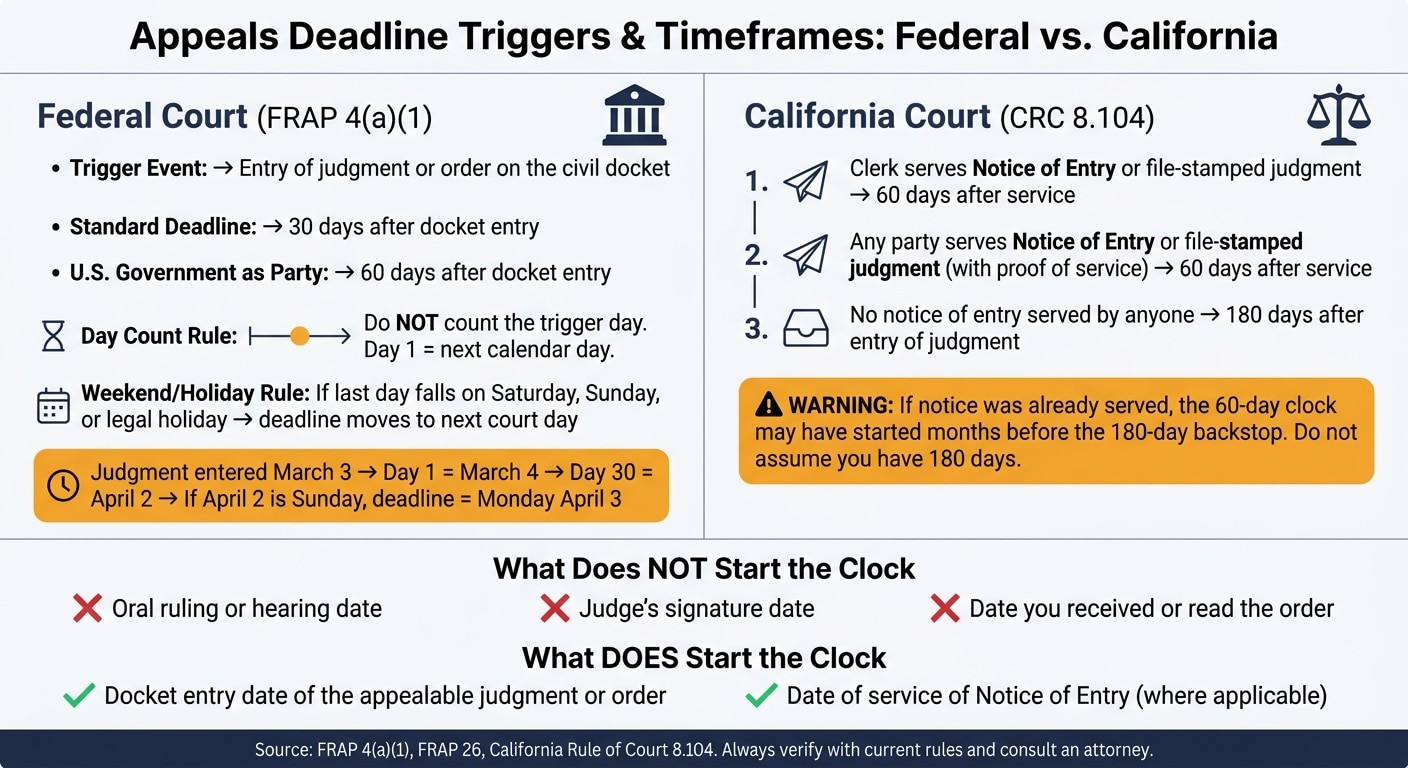
Federal vs. State Appeals Deadlines: Key Triggers & Timeframes
A lot of pro se litigants know how long they have to appeal. The problem is when they start counting.
This mistake usually comes from using the wrong event as the trigger date. If you start from the wrong date, even a correct deadline length won’t save you.
Confusing Oral Rulings, Minute Orders, and Final Judgments
A judge’s oral ruling usually does not start the appeal clock. In civil cases, the clock usually starts when an appealable judgment or order is entered on the docket.
That’s where people get tripped up.
A minute order is just a short court record showing what happened. But it is not always the appealable order. And the date that matters is usually the docket entry date – not the judge’s signature date and not the hearing date.
Once you know which document starts the clock, check whether your court uses entry, service, or both.
Missing State-Specific Trigger Rules
Federal and state courts don’t all use the same trigger. That’s a big deal.
In federal civil cases, the default rule under FRAP 4(a)(1) is 30 days after entry of the judgment or order, or 60 days if the United States or a federal agency is a party.
California uses a different setup. Under California Rule of Court 8.104, the notice of appeal is due by the earliest of three events:
| Triggering Event | Deadline |
|---|---|
| Clerk serves a Notice of Entry or file-stamped judgment | 60 days after service |
| Any party serves a Notice of Entry or file-stamped judgment (with proof of service) | 60 days after service |
| No notice of entry is served by anyone | 180 days after entry of judgment |
This is where people get burned. Someone sees the 180-day outside limit and assumes they have plenty of time. But if notice was already served, the 60-day clock may have started long before that. In plain terms: waiting for the backstop can make you late by months.
Check your state rule before you count.
After you find the right rule, confirm the exact date on the docket before doing any math.
How to Confirm the Controlling Date from the Docket
The safest move is simple: verify the trigger first, then count.
Before you calculate the deadline, confirm:
- the triggering document
- the docket entry date
- any notice of entry or service
- the resulting deadline
Keep the judgment, docket sheet, and notice of entry with proof of service together. Then write down the trigger date before you start counting.
My background is in library and information science, and that turned out to be the most useful thing I brought into a courtroom. When I was preparing my appeal, I didn’t trust my memory of what the court had done — I went back to the docket and read the actual entries. What I found was that the document I thought had ended my case and the document that legally ended my case were not the same thing. Pull the docket sheet. Read the entry, not your recollection of the hearing.
Mistake 2: Counting the Deadline Incorrectly
Once you have the right trigger date, the next place people slip up is the count itself.
Counting from Receipt Instead of Entry or Service
After you identify the trigger date, do not start counting from the day you first saw the order. The appeal clock does not begin when the order hits your email, e-filing account, or mailbox. In federal civil cases, it generally starts when the judgment is entered on the civil docket. The day you personally read or receive the order does not control.
Here’s the problem in plain English: if judgment was entered on March 1, but you did not open the mailed copy until March 8, your 30-day clock still started on March 1 – not March 8. So once you confirm the trigger date, use that date for the count.
After that, the next mistake is simple but costly: counting the days the wrong way.
Miscounting Days, Weekends, and Legal Holidays
Under FRAP 26, you do not count the trigger day itself. Day 1 is the next calendar day. Then you count every calendar day after that, including weekends and legal holidays. If the last day lands on a Saturday, Sunday, or legal holiday, the deadline rolls to the next court day.
A short example makes this easier:
- Judgment is entered on March 3
- Day 1 is March 4
- Day 30 is April 2
- If April 2 falls on a Sunday, the deadline moves to Monday, April 3
That rule sounds simple, but it trips people up all the time. One skipped day at the start can throw off the whole count.
Also, treat the computed deadline as the last possible filing date, not the date you plan around. Filing several business days early gives you some room if something goes sideways.
Even if your count is right, there’s another hard truth here: a late appeal often can’t be fixed after the fact.
Why a Late Appeal Often Cannot Be Saved
Missing the deadline by even one day in a federal civil case is usually fatal. In Bowles v. Russell, the Supreme Court held that statutory appeal deadlines are mandatory and jurisdictional, so a court of appeals has no power to hear a late notice of appeal.
That rule is harsh, but the message is clear. Sympathy will not save a late filing. Confusion will not save it. Relying on a court’s mistaken order will not save it either.
There is no grace period. If the clerk accepts the notice, that still does not make it timely. The appeal can be dismissed later when the court checks jurisdiction. In other words, a bad count can end the appeal before the court ever gets to the merits.
The next trap is assuming a motion or extension adds time automatically.
Mistake 3: Assuming motions or extensions automatically add more time
A lot of pro se litigants assume that any post-judgment motion, or any request for more time, stops the appeal clock. It doesn’t. Only a small group of post-judgment filings pause the deadline, and getting extra time takes a separate motion.
Not knowing which post-judgment motions toll the deadline
Under FRAP 4(a)(4), only certain timely post-judgment motions stop the appeal clock. If one of those motions is filed on time, the appeal deadline runs from the order disposing of that motion.
A Rule 59 motion stops the deadline only if you file it within 28 days after judgment, and the court cannot extend that 28-day period. If the motion falls outside that rule, the original appeal deadline still controls.
A motion called “reconsideration” is a common trap. Courts care about what the motion does and when it was filed, not the label on it. And filing one post-judgment motion after another does not keep resetting the clock.
Here’s the part that stumped me, and I say that as someone with a research doctorate. The big Latin terms were never the problem — res judicata, prejudice, affirmative defenses, I could look those up and understand them fine. It was the small words. Does “shall” mean it has to be done? Does “may”? Does “should”? Whether your motion tolls the deadline turns on exactly those words, so read the rule slowly, and then check how courts have actually read it.
Misunderstanding extension requests under Federal Rule of Appellate Procedure 4(a)(5)
If the original deadline is close, don’t assume an extension request buys you time. It has its own deadline. FRAP 4(a)(5) allows a narrow extension, but only if you file a motion within 30 days after the original deadline expires and show good cause or excusable neglect.
That means an extension request does not bring back a missed deadline unless it is filed within that separate Rule 4(a)(5) window. In civil cases, the new deadline cannot be more than 30 days after the original deadline or 14 days after the order granting the extension, whichever is later.
Setting a primary and backup deadline plan
From the day judgment is entered, track two separate dates.
- Your primary deadline is the original notice-of-appeal deadline: 30 days from entry of judgment in most federal civil cases involving private parties.
- Your backup deadline applies only if you file a clearly qualifying, timely tolling motion under Rule 4(a)(4). In that situation, the appeal period runs 30 days from the court’s order disposing of that motion.
If you’re not sure whether your motion qualifies, play it safe. Treat the primary deadline as the one that matters and file the notice of appeal before it runs out.
How to avoid deadline mistakes before they end your appeal
Once you know the trigger date and the counting rule, the next move is simple: turn that deadline into a filing plan. Getting the date right matters. But it only helps if you also have a system that gets the notice filed on time.
Build one reliable deadline system for your case
These deadline problems usually happen when people react at the last minute instead of planning ahead. Pick one place to track every appeal date and use it for the whole case. That can be a notebook, a calendar with a single deadlines page, or a digital calendar linked to a simple spreadsheet. The key is to avoid scattered notes.
For each entry, record five things:
- The event that started the clock
- The rule that controls the deadline
- The exact due date
- The filing task tied to that date
- The current status of that task
Set reminders for 30, 14, 7, and 3 days before the deadline. Give each reminder a job. Early reminders can help you confirm the date, draft the notice, and get the filing done before time runs out. Use one system that keeps the triggering event, deadline rule, due date, and filing task in the same place.
Then turn each deadline into a plain, usable filing checklist.
Tie each deadline to a specific filing task
A due date by itself doesn’t do much. Every deadline should connect to a task list that gets finished before that date arrives.
For the notice-of-appeal deadline, that list should cover drafting the notice with the correct case caption and case number, confirming the filing fee amount and payment method, checking whether you must use e-filing or in-person filing and what the clerk’s office hours are, preparing proof of service, and reviewing local appellate rules for any circuit-specific requirements.
Set your own internal filing date 3 to 5 days early. Treat that earlier date as the one that counts. That buffer can save you if the clerk rejects the filing for a technical error, if the e-filing system goes down, or if life throws something at you at the worst possible moment. In appeals, a late notice is often jurisdictional and cannot be excused, so filing early is one of the simplest ways to protect yourself.
I want to leave you with what happened after I filed that appeal on time. I did the research myself, wrote the brief myself, and the reversal came back so swift and so brutal that the trial judge recused himself from my case entirely. It went to a different judge. I’m not telling you that to brag — I’m telling you because losing at the trial level is not the end, as long as you protect your right to be heard by the next court. That protection is a date on a calendar. Guard it.
Conclusion: Identify, calculate, and file early
Every appeal deadline mistake in this article comes back to three problems: not knowing what starts the clock, counting the days the wrong way, or assuming something else will give you more time. Courts don’t go along with those assumptions.
The fix is direct: identify the triggering event on the docket, apply the right rule to calculate the deadline, build a task-based plan around an early internal filing date, and review your calendar every week. A disciplined process – not luck and not last-minute scrambling – is what keeps the right to appeal intact.
FAQs
How do I know which order is appealable?
Generally, you can appeal only final judgments that fully end a case. That includes rulings after trial, summary judgments, and dismissals.
Some states also let parties appeal certain interlocutory orders. These orders do not end the case, but they can have a major effect on your rights. Common examples include orders tied to jurisdictional disputes or injunctions.
In most situations, an appeal needs to rest on a legal or procedural error. It’s not enough to simply disagree with how the facts were viewed.
What if I never received a notice of entry?
If you didn’t receive a notice of entry, contact the court clerk right away and explain what happened. Filing deadlines are enforced very strictly, so move fast to protect your rights.
You may need to file a motion asking for more time or for other relief. Be ready to provide documents that show good cause or excusable neglect.
Should I file a notice of appeal if I’m unsure a motion tolls the deadline?
Yes. If you’re not sure whether a motion pauses the deadline, file your notice of appeal anyway.
Appeal deadlines are enforced strictly. Miss the filing window, and the court will usually dismiss the appeal.
So the safer move is simple: file within the standard deadline – often 30 to 60 days after the judgment – instead of gambling on a tolling mistake.