
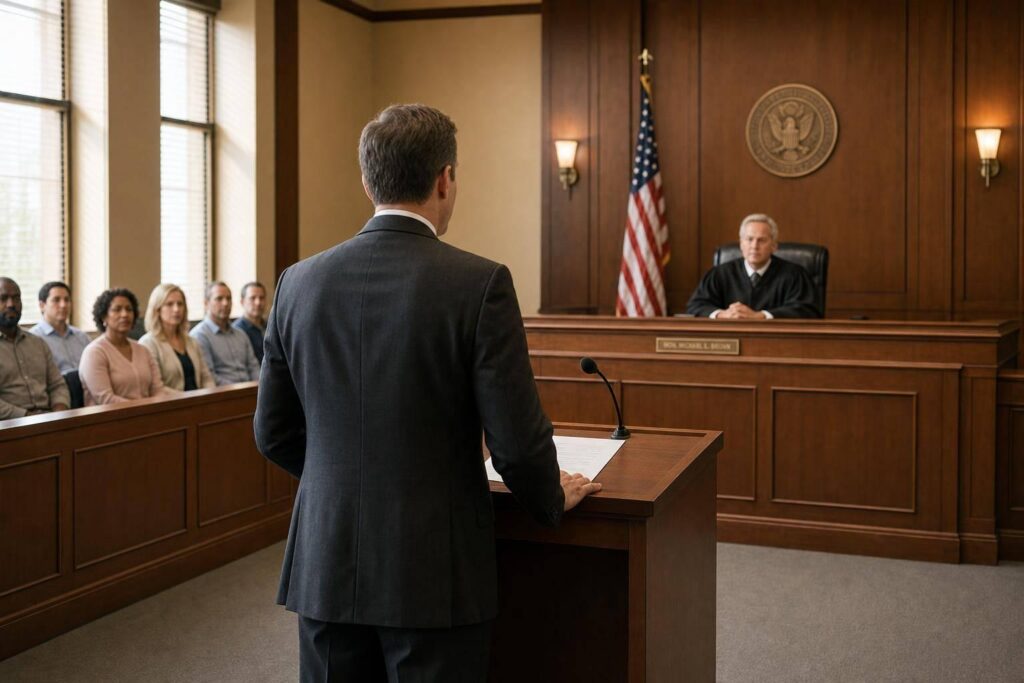
In U.S. civil court, the short rule is simple: speak to the judge as “Your Honor,” speak to jurors only when the court allows it, and keep your tone calm, direct, and formal. If you do that, you cut the risk of looking careless, rude, or out of control.
Here’s the full article in plain English:
- Know who you’re talking to. Hearings and motions usually go to the judge, not the jury.
- Use the right title. Say “Your Honor” to the judge and “the Court” when referring to a ruling or the judge’s role.
- Do not talk to jurors outside court. That includes the hallway, elevator, parking lot, restroom, and online.
- Answer the judge with short, clear replies. For example: “Yes, Your Honor” or “No, Your Honor.”
- Ask permission before moving or handing up papers. A simple “Your Honor, may I approach?” works.
- Address jurors only in allowed parts of trial. That usually means opening, witness exam, and closing.
- Watch your body language. Eye-rolling, sighing, slouching, or reacting at counsel table can hurt how people see you.
- Speak for the record. Court reporters can’t record nods or shrugs, so say your answer out loud.
A 2023 Pew Research Center survey found that about 62% of U.S. adults had little or no confidence in the criminal justice system. That makes courtroom conduct matter even more: people notice respect, control, and clarity fast.
| Situation | What I should do |
|---|---|
| Speaking to the judge | Say “Your Honor” |
| Referring to a ruling | Say “the Court” |
| Answering a question | Keep it short and direct |
| Wanting to move or approach | Ask permission first |
| Speaking near jurors | Stay neutral and formal |
| Seeing a juror outside court | Do not talk; tell court staff |
Bottom line: I should let my words stay plain, my posture stay steady, and my comments stay on the record. That is the core of the article.
None of this is about deference for its own sake. When you’re representing yourself, formality is armor. A lot of judges shift into Judge Judy territory the moment they see a pro se litigant — the rules they would be forced to follow with two lawyers in the room get noticeably looser. Sounding like someone who belongs in that room is the cheapest way to make that harder to do.
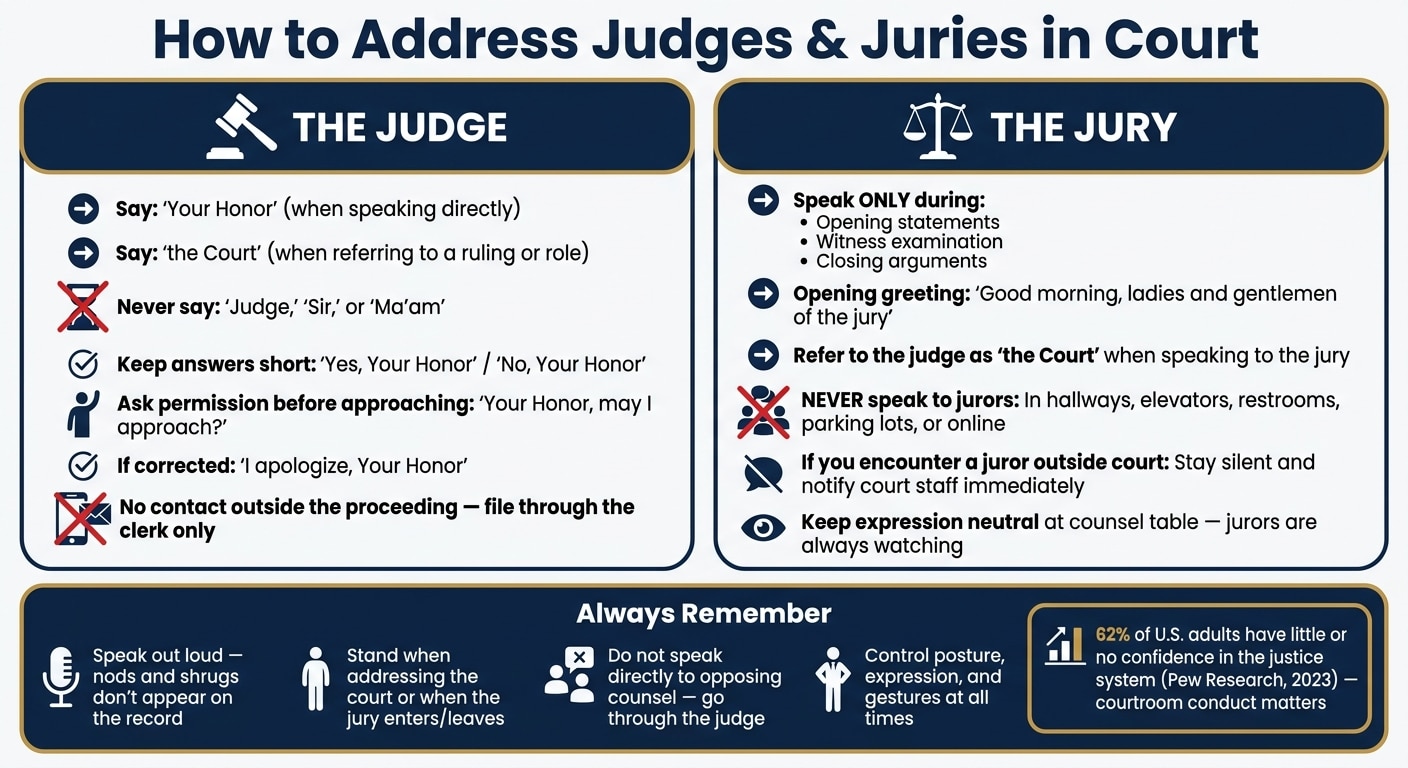
How to Address Judges vs. Juries in Court: Quick Reference Guide
Your Honor: The proper way to address the Judge in court
Know Who You Are Addressing in Court
Before you say anything in court, get clear on who you’re speaking to. That changes the way you present your point and even the words you use.
When to speak to the judge and when to speak to the jury
Hearings and motion arguments go to the judge only. Jurors should be addressed only during approved parts of a trial: voir dire if the court allows it, opening statements, when witnesses testify before the jury, and closing arguments.
One more rule matters here: do not speak straight to opposing counsel during the proceeding. Speak to the bench and go through the judge.
What ‘Your Honor’ and ‘the Court’ mean
In open court, use “Your Honor” when speaking to the judge. Use “the Court” when referring to the judge’s authority or to a ruling. Do not call the judge “Judge”, “Sir”, or “Ma’am.” Use “Your Honor.”
Once you know the right terms, stick with them every time you address the judge.
Why you must never speak to jurors outside formal proceedings
Any contact with jurors must happen only when the court allows it and only on the record. That means no hallway chats, no elevator talk, no restroom contact, no parking lot conversation, and no online contact. Even casual contact can make it look like one side is trying to sway the jury, and that can hurt the case.
If you run into a juror in a public part of the courthouse, don’t start a conversation. Tell the judge or the courtroom deputy at once. Improper contact can lead to contempt of court, which may bring fines or jail time.
With the roles clear, the next step is speaking to the judge in a direct, formal way.
How to Speak to the Judge Properly
What to say when your case is called
Once you know the right title, keep your replies brief, formal, and on the record. When your case is called, stand at the lectern or podium. If the judge or clerk asks for appearances, say: Your Honor, my name is [Full Name], and I am the [plaintiff/defendant]. Speak clearly and slowly so the record is accurate. Don’t rely on nods, hand motions, or facial expressions.
After that, answer only the question the judge asks.
My first time addressing a judge, I was a broke graduate student in Raleigh contesting a seatbelt ticket. I had subpoenaed the officer, so I was standing there questioning a police officer on the stand, and I kept it to plain questions: Was I speeding? Was anyone else in danger from my behavior? What was out of order that required the state to intervene that evening? I didn’t editorialize and I didn’t argue with him. The judge said he couldn’t declare the law unconstitutional, but he told me I didn’t have to pay the ticket. Short, specific, on point — that’s what got heard.
How to answer questions and make requests clearly
Keep your answers short and direct. For direct questions, use Yes, Your Honor or No, Your Honor. Don’t add extra details unless the judge asks for them. If the judge cuts in, stop at once and listen. Then respond. If you don’t understand the question, say, Your Honor, I do not understand the question. If you need to speak up on a point, wait for a natural pause and ask, Your Honor, may I be heard?
Before you move, ask for something, or hand over papers, get permission first. Give documents to the clerk or courtroom deputy rather than walking them up yourself. If you need to leave your spot, ask: Your Honor, may I approach?
How to avoid informal or improper communication with the judge
Do not contact the judge outside the proceeding. Do not contact chambers directly. File any written communication through the clerk and serve opposing counsel.
If the judge rules against you, note your objection and move on. If the judge corrects or reprimands you, say, I apologize, Your Honor, and stop.
Note it, and make sure someone is writing it down. In our Florida foreclosure case, the judge’s emergency order referred to us as “the borrowers” — which is a bit like calling a defendant “the killer” before trial. I said so on the record, respectfully. She backed all the way off, and the case management order she issued afterward was very favorable to us. That hearing went that way because we had a court reporter present. Without one, an objection is just something you said out loud in a room.
If jurors are in the courtroom, keep the same discipline and limit your remarks to approved trial moments.
How to Address the Jury During Trial
Once the judge turns to the jury, your job changes a bit. Stop sounding like you’re talking to the bench and start speaking in plain, direct English. Address jurors only during the parts of trial where that is allowed, and only when the judge permits it.
How to open an opening statement
Start with a short, respectful greeting: “Good morning, ladies and gentlemen of the jury.” Then move straight to your theme in simple language. Give jurors a clear preview of what the evidence will show.
Opening statement is not the time to argue the law. If you need to refer to the judge while speaking to the jury, say “the Court.” Stand when you address the jury. Make steady eye contact. Speak slowly enough that the record stays clear.
How to deliver a closing argument without overreaching
Closing argument is your last shot to connect the evidence to the verdict you want. Keep it tied to the admitted evidence, the jury instructions, and the relief you are asking for.
Stay with the record: witness testimony, exhibits, and the judge’s instructions. Don’t ask jurors to guess about facts that never came into evidence. And don’t drift into emotional overstatement or personal attacks on the other side.
How to stay within courtroom limits when jurors are present
Even when you’re silent, jurors are paying attention. That means your conduct matters from counsel table too. Do not speak or react while a witness is testifying. If you hear something that goes against your case, write it on your notepad instead of showing it on your face.
Keep your expression, hands, and posture neutral while jurors are in the room. Do not approach the jury box without the judge’s permission. And always stand when the jury enters or leaves the courtroom.
Control Your Tone, Pace, and Body Language
Once your words are in place, your delivery needs to line up with them. How you speak and carry yourself shapes how the judge and jury take in everything you’ve said so far.
How to sound calm, clear, and composed
Speak slowly and clearly so the record stays accurate. Project your voice enough for the court to hear you, but keep your tone conversational, not hostile. Say each answer out loud. A nod or shrug won’t appear on the record.
If a question throws you for a second, pause before you answer. That short pause can help you stay steady and avoid saying something sloppy. Skip sarcasm, muttering, or letting your voice trail off.
Tone is only one piece of courtroom presence. Posture and movement matter just as much.
How to use posture, eye contact, and movement in court
Stand upright at the podium with your hands relaxed at your sides or resting lightly on the lectern. Face the judge when you’re addressing the bench, and turn to the jury only when you’re allowed to. Your body should match the person you’re speaking to.
Use natural eye contact. Don’t stare, and don’t keep looking down. Avoid pacing, crossing your arms, or putting your hands in your pockets. Don’t point hard or wave papers around. Small, controlled gestures tend to read as confident. Big, dramatic movements can look distracting.
Courtroom demeanor: effective vs. problematic behavior
- Posture: Stand upright when speaking vs. slouching or staying seated while addressing the court.
- Expression: Keep a calm, neutral face vs. eye-rolling, visible frustration, or audible sighs.
- Gestures: Use controlled movements or keep hands at your sides vs. waving papers or pointing aggressively.
Conclusion: Use Formal Address, Stay Respectful, and Let the Record Speak
Call the judge “Your Honor.” When you refer to the judge in the third person, say “the Court.” And only speak to jurors during the parts of trial when that is allowed.
When the hearing or trial ends, offer a brief thank-you to the judge. If the ruling goes against you, say, “I apologize, Your Honor,” and stop.
Before you walk into court, give everything one last review. The local rules and the judge’s standing orders are what control. Check the court’s website before you appear, and ask the courtroom deputy about any step you don’t understand – they can explain the judge’s procedures.
I’ll admit I have not always been composed. When a judge dismissed our first eviction case — he read the file, started shaking his head, and said the plaintiff hadn’t met the elements of an eviction — I yelled “Thank you, your Honor!” from across the courtroom. People stared at us on the way out like they wanted some of whatever we’d had. So aim for formal and restrained, and give yourself a little grace on the way out the door. Being polite in that room is not the same as being small in it.
Respect, clarity, and restraint help keep the record centered on your case.
FAQs
What if I call the judge the wrong title?
If you address a judge the wrong way, apologize right away and move on with the correct title. A simple, polite response like “I apologize, Your Honor” is enough.
Your Honor is the standard and safest way to address a judge in any U.S. courtroom. If you get flustered, take a brief pause and stay calm.
Can I speak to a juror outside the courtroom?
No. You must not speak to a juror outside the courtroom. Keep a respectful distance and avoid anything that could look too familiar.
You also may not address a juror one-on-one or by name during jury argument. Clear professional boundaries help protect the integrity of the trial process.
What should I do if I do not understand the judge’s question?
If you don’t understand the judge’s question, ask for clarification instead of guessing or giving the wrong answer.
You can say, “Your Honor, I’m sorry, but I do not understand the question.” This helps you stay accurate and can keep you from giving damaging information.