
Quiet Title Case?
Harold Handled It Without a Lawyer.
Harold had lived in his home for 30 years. His deed clearly described the property boundaries. But the construction company building the apartments had relied on a faulty survey. They were claiming a strip of land that belonged to Harold — and they were already building on it.
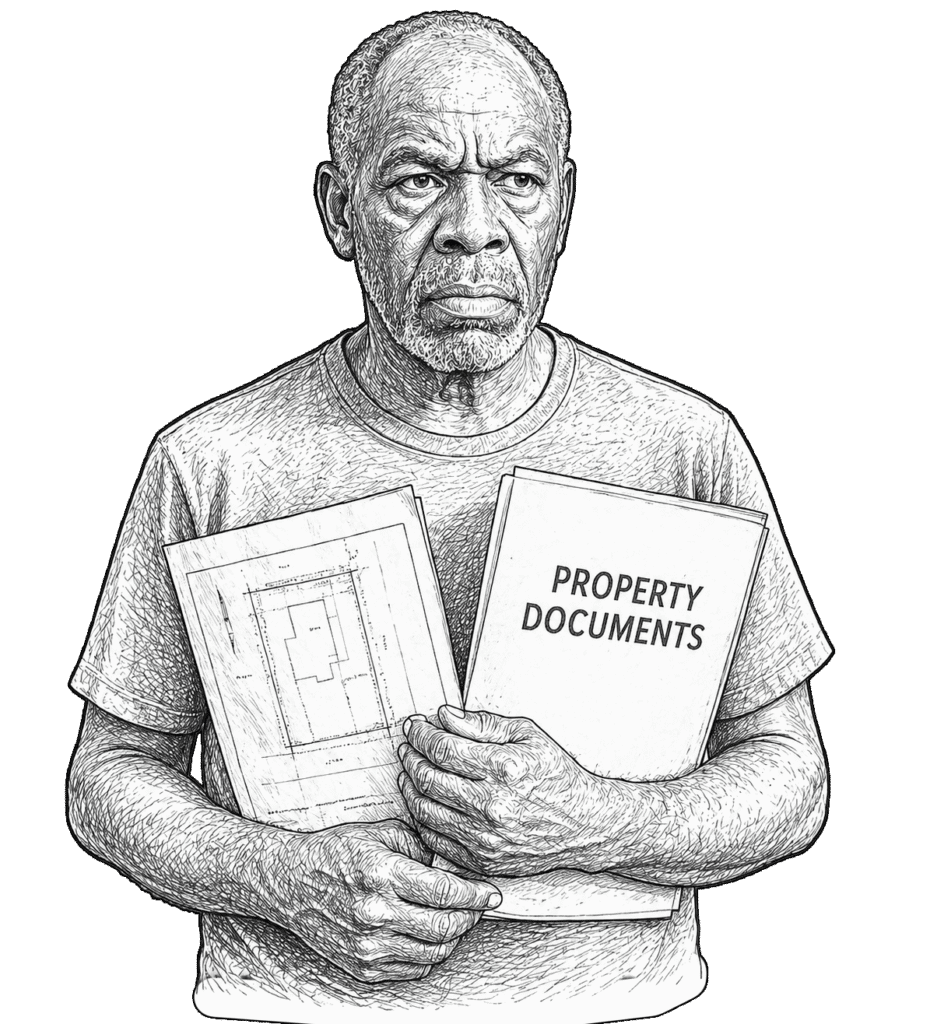
The Dispute
Harold knew the only way to stop them was to assert his ownership in court. That meant filing a quiet title lawsuit — and that’s where the LAW Accelerator came in.
Filing His Case With the Accelerator
Harold joined the LAW Accelerator and followed the Accelerator’s Personal Practice of Law — a 5-step AI-guided process to take legal action on his own.
The Accelerator helped Harold select the correct legal action: a quiet title complaint. The goal was to ask the court to confirm his ownership and bar the builder from claiming the land.
The Accelerator provided the state court rules and helped Harold understand what to include in his complaint: a legal description of his property, the disputed area, and evidence of his ownership. He also learned how to serve the construction company properly.
Using the Accelerator, Harold broke down the facts:
- His deed and property survey showed clear boundaries.
- The apartment builder’s fence crossed into his yard.
- The builder refused to stop construction.
These facts supported a strong claim for quiet title and injunctive relief.
The Accelerator suggested terms like “quiet title property boundary dispute” and “adverse possession by developer.” Harold found cases where courts ruled in favor of homeowners with clear title. The Accelerator summarized those cases to help him cite them in his filings.
With all the pieces in place, the Accelerator generated a professional quiet title complaint and a motion for preliminary injunction to stop further construction. Harold filed them both and served the defendant.
Getting to Court
The builder’s lawyer tried to dismiss the case, but Harold used the Accelerator to respond:
- He summarized the motion to dismiss
- Updated his fact pattern and legal arguments
- Generated an opposition brief citing clear case law
The judge denied the motion and set a hearing on the injunction.
Protecting His Property
At the hearing, Harold presented:
- His deed and property survey
- Photographs of the boundary line
- A timeline showing the builder’s construction activity
The Accelerator helped him build a trial notebook to organize his evidence and outline his statements. The judge granted the injunction, halting the construction across the line.
The Final Outcome
After several months of litigation, the builder agreed to settle. They moved the fence back to the correct property line, paid for repairs to Harold’s yard, and recorded the corrected boundary with the county.
What Harold Learned
Harold had no legal experience. But with the Accelerator, he was able to:
⚖️
Understand real property law
🔍
Analyze the facts of a boundary dispute
📚
Research quiet title cases
📄
Draft strong legal documents
✅
Win in court without a lawyer
“My family owned that land for three generations. No way I was letting someone take it without a fight. Turns out, the law was on my side the whole time.”
— Harold, Quiet Title Case
You Can Do It Too
If someone is claiming land that belongs to you — and you can’t afford a lawyer — don’t give up. Courtroom5 helps you defend your rights in court.
Start your Personal Practice of Law today. Your land. Your case. Your tools.
Join thousands who’ve fought back.