
Child Custody Case? How Danielle Protected Her Children’s Routine Without a Lawyer
Her former husband hired a lawyer and asked the court to move the children. Danielle had the school records, the routine and no lawyer.
A composite story drawn from member experiences. Details below.
Danielle knew which backpack held the library book and which afternoon needed an early pickup. Since the divorce, the children had lived primarily with her and spent scheduled time with their father. It wasn’t effortless, but school mornings had become predictable.
Then her former husband hired a lawyer and asked the court to change custody. His lawyer’s papers questioned her parenting and proposed that the children live primarily with him.
He had someone who knew the rules, the deadlines and how to talk to a judge. Danielle was afraid she could lose her children’s routine simply because she couldn’t keep up, even with records that mattered.
She read the allegations after putting the children to bed. Her first impulse was to answer every accusation with the history of the marriage. But the court wasn’t deciding who had the angriest account of the divorce. It was deciding what arrangement served the children.
See if your case qualifies →5 questions. 2 minutes. $1 once. Nothing renews.
First, the papers and the dates

Danielle put the current custody order beside the new request. She checked exactly what her former husband wanted changed, how and when she had to respond, the service requirements and the hearing date. A custody request isn’t something you answer with a text message.
She also looked up the standard for changing an existing order. The children’s best interests mattered, but most courts also require something more before they’ll modify custody, and she needed to know what her court required.
She kept two calendars. One held filing and hearing dates. The other still held school, appointments and everything else the children needed her to remember.
Proof: the children’s routine needed a record

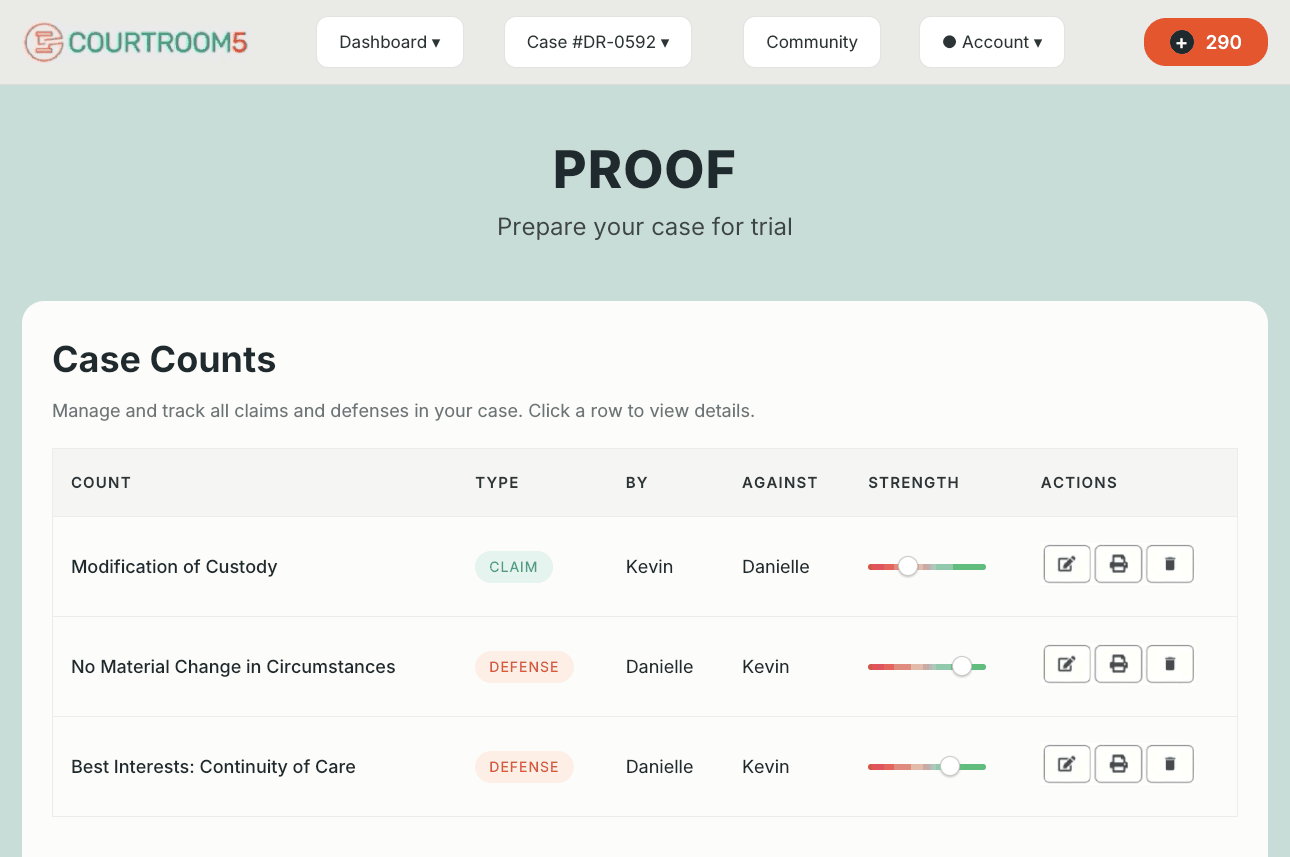
In Proof, Danielle described the dispute in plain language, then connected each legal issue to facts and evidence. She sorted the allegations into what she could answer from records, what she disputed and what still needed checking.
School attendance records showed continuity. Appointment records showed care. Messages about pickups showed what the parents had agreed and what actually happened. No single record proved one parent should have every decision or every overnight.
What Danielle had to support
A custody change turns on records and the children’s needs, not on the history of the marriage. Here’s what she matched to each question.
| Question | Her evidence |
|---|---|
| What arrangement is already in place? | The current custody order and the schedule the family actually followed |
| What keeps the children stable? | Attendance records, school messages, appointment records and her work schedule |
| What has actually changed? | Dated records addressing the specific changes alleged in the request |
| Would her proposed schedule work? | School hours, both parents’ availability and specific exchange terms Gap found Her calendar logged late pickups, but several entries were missing the messages showing the time had been changed by agreement. |
Custody standards, modification requirements and evidence rules vary by state. Proof shows the elements that apply in your court.
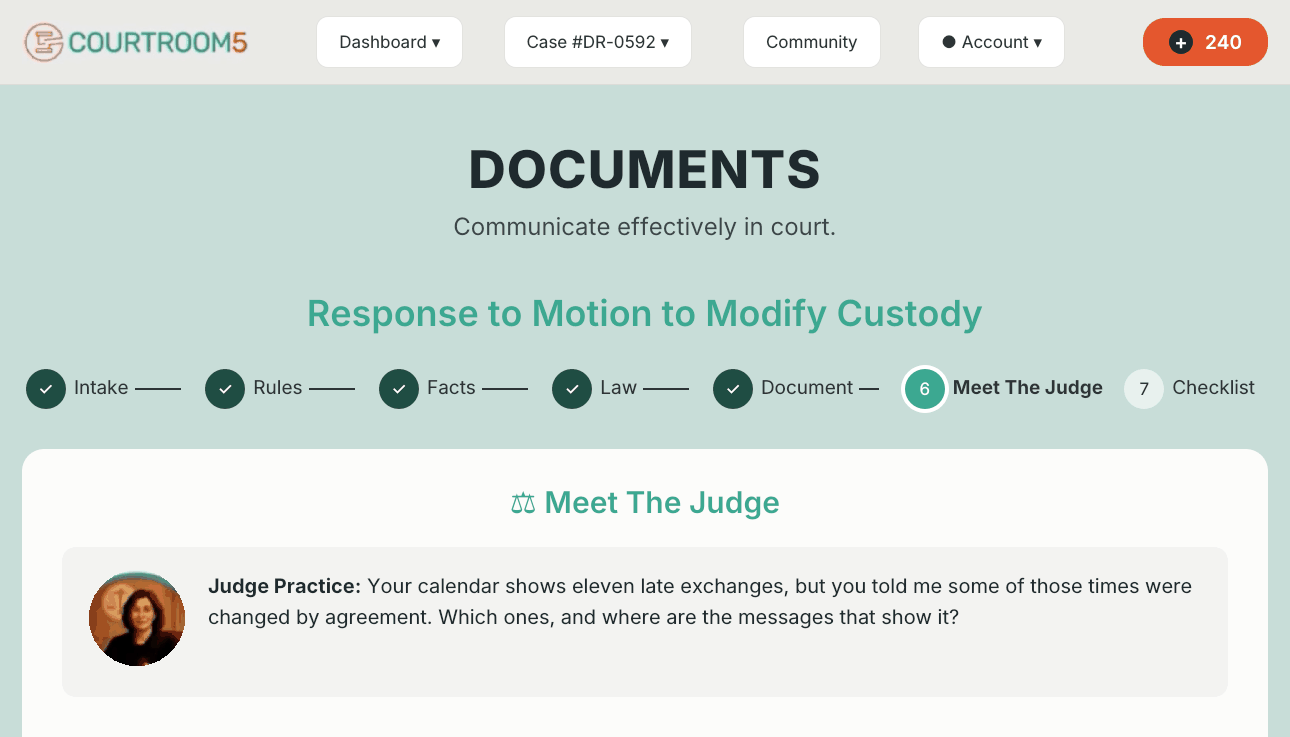
Her first calendar made every late exchange look like a broken agreement. Checked against the full message threads, some of those times had been changed by mutual agreement. She corrected those entries and tied each remaining problem to the original message.
Her account got smaller and more credible. She could show the real scheduling problem without asking the court to accept a count she couldn’t defend.
At 2 am, one piece at a time

During the day, Danielle kept moving: breakfast, work, pickup, homework. At night, she pictured his lawyer making a confident argument while she hunted for the right page. She was afraid the judge would hear a prepared case from him and only panic from her.
One night at 2 am, she opened the LAW Accelerator and connected one school record to one fact. She watched a lesson in the Learning Center, read a community discussion and posted a question of her own. Seeing other people work through the same uncertainty helped her stop treating it as proof she was failing.

She worked after bedtime and on lunch breaks rather than turn every evening into a case meeting. The children didn’t need to hear each new allegation, choose a side or carry messages between their parents.
She could prepare for court and still be their parent. She had to do both.
Strategy: answer the request, not the whole marriage
Danielle uploaded the custody request to Strategy and read the plain-English summary of the issues and her options. The question wasn’t everything that had hurt her. It was whether the requested change should be made under the standard her court applied.
She chose to oppose moving the children and to propose a more specific parenting schedule: the school-week routine stayed central, with meaningful time for their father. She didn’t ask for supervised visits just because the adults communicated badly.
In Documents, she researched the modification standard, reviewed the response rules and drafted a declaration tied to her records. Then Judge Practice asked her the questions a judge was likely to ask, starting with the calendar she’d already had to correct.
Her proposal had dates, exchange times, a location and a way to communicate about changes. It was an arrangement someone could follow, not a request that the other parent become more reasonable.
Got a custody request, a hearing date or a parenting schedule that isn’t working?
See if your case qualifies →$1 gets you 100 credits and community access. Nothing renews.
Mediation narrowed the fight

Her court required custody mediation before the hearing. Danielle checked how it worked there: what stayed confidential, whether the mediator reported to the judge and how to raise concerns about participation or safety.
She brought her proposed schedule and the records behind it. She could explain why the school-night arrangement worked, where exchanges had broken down and what she could accept. She listened to his scheduling concerns without treating every concession as a loss.
They agreed on clearer exchange times, one communication channel and several holiday arrangements. They did not agree on where the children would live during the school week. Danielle left with a smaller dispute, and the court wouldn’t have to decide every pickup time from scratch.
At the hearing, she had a plan she could explain

Danielle practiced a short explanation: the current order, the change requested, the records that bore on it and the plan she proposed. She practiced answering questions, not giving a speech about the divorce.
His lawyer argued for the change and challenged her account of the exchanges. Danielle still felt outmatched, but she didn’t have to answer from memory. She turned to her Trial Notebook, acknowledged the calendar entries she had corrected and walked through the remaining problems with the messages behind them. When the judge asked how her schedule would work, she pointed to school hours, work schedules and specific exchange terms.
The court declined to transfer primary care. The children would keep living primarily with Danielle, with a defined parenting-time schedule for their father. The order folded in the mediated arrangements and set the remaining school-week and exchange terms.
It didn’t declare Danielle a perfect parent or settle every disagreement between the adults. It was a workable plan built on the issues the court actually had to decide.
What a case like this costs
On Courtroom5, you see the price of every step before you take it. Typical ranges:
- Analyzing your case and the legal issues: about 165–270 credits
- Drafting one document (such as a response or a declaration): about 225–725 credits
- Preparing for and responding to discovery: about 420–1,385 credits
Your first 100 credits are $1. After that, credits are 15¢ each, or 1,000 a month with Max for $99. Community, office hours and courses never use credits.
Plan for outside costs too. Custody cases can involve filing and service fees, mediation fees or a required parenting class. Many courts offer fee waivers. Courtroom5 doesn’t cover these.
The result was a routine, not a trophy

Danielle read the entered order for what it required, confirmed the dates and put the new schedule on the kitchen calendar. The order didn’t make co-parenting effortless. It made the next exchange less uncertain.
Her former husband still had a lawyer. Preparing didn’t make her one. It let her answer his argument with records and a plan instead of letting the difference in experience leave her silent.
When the children asked about next weekend, she could tell them where they’d be and when they’d come home. They didn’t need to know who had won in court. They could go back to being children.
Facing a custody request? Start here.
Read the papers, check your response and hearing dates, and gather the current order and the records that speak to the change being requested. If you’re ready to prepare, see whether the LAW Accelerator fits your case.
See if your case qualifies →5 questions. 2 minutes. $1 once. Nothing renews.
About this case study. Danielle is a composite drawn from the experiences of Courtroom5 members, not a report of one person’s case. Outcomes vary. Custody standards, modification requirements, mediation and evidence procedures depend on your case and jurisdiction. This case study is not a promise of results.
See if we can help. Start for $1