
Breach of Contract Case? How Simone Prepared Hers Without a Lawyer
Simone had a business to run. The canceled contract became another job.
A composite story drawn from member experiences. Details below.
Two days before the conference, Simone’s phone lit up with a short email: the company was canceling. Internal budget cuts. No rescheduled date.
She had already paid venue and supplier deposits, ordered supplies and booked staff. The contract covered late cancellation, but the company refused to reimburse a dollar. Simone ran her business as a sole proprietor, so the contract was in her own name, and so was the loss.
She read the email again between unloading linens and picking up her daughter from after-school care. She had spent years making her business dependable. Now she wondered how she would pay the people who depended on her.
See if your case qualifies →5 questions. 2 minutes. $1 once. Nothing renews.
Before she sued, she sorted what she could prove
Her first draft was a furious email. She left it unsent.
Instead, she gathered the signed agreement, the cancellation email, invoices and payment confirmations. She read the contract’s dispute terms: no arbitration clause. She checked which court had jurisdiction over a claim her size, and decided on a regular civil case rather than small claims.
She also separated what she’d spent from what she’d hoped to earn. Some supplies could be reused. Some deposits came back. Counting everything as a total loss would have made her demand bigger, but not stronger.

Proof: give each fact a job
Simone started in Proof. She told it what happened in plain language, and it broke her story into individual facts and connected each one to the elements of a breach-of-contract claim. Then she attached her evidence.
What Simone had to prove
Every breach-of-contract claim has parts. Here’s how she matched her evidence to each one.
| Element | Her evidence |
|---|---|
| A valid contract existed | The signed agreement, including the late-cancellation terms |
| She did her part | Vendor confirmations, staff bookings, supply orders |
| The company broke it | The cancellation email and the refusal to reimburse |
| She lost money because of it | Receipts and bank confirmations, minus refunds and reusable supplies Gap found An invoice showed what a supplier charged, not that she paid it. She added the bank record. |
Elements and their wording vary by state. Proof shows the elements that apply in your court.
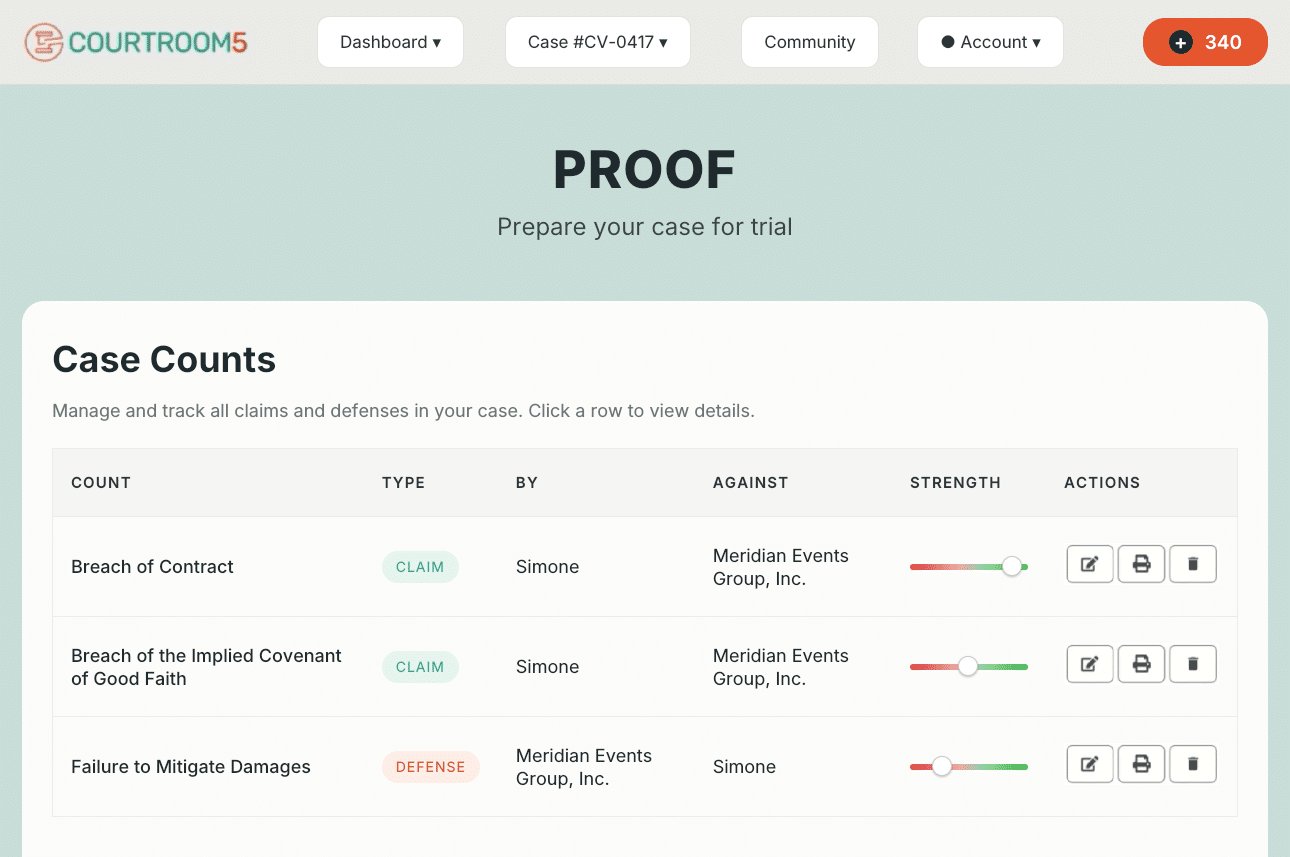
She built her Trial Notebook around those connections, and it became a record she could explain rather than a pile of paper. She kept the company’s objections in view, too. Preparing her case meant understanding their side, not ignoring it.
At 2 am, the next piece was small enough to do

The first weeks were hard. She worried about money during the day and rehearsed arguments at night. Being dropped by a big customer had felt personal. Being questioned by its lawyer felt worse.
One night at 2 am, after an hour of staring at the ceiling, she opened her laptop. She didn’t try to finish the lawsuit. She connected one payment record to one fact and watched a Learning Center lesson on proving damages. Then she posted a question in the community and went back to bed. Reading how other members kept their records organized made her feel less alone.
She made herself a rule: one work block before breakfast, two evenings a week, and no lawsuit talk at dinner.
Strategy: understand the motion before you answer it
After she filed and served her complaint, the company’s lawyers moved to dismiss it. Simone’s first instinct was to send the judge every receipt she owned.
Instead, she uploaded the motion to Strategy and read the plain-English summary of where her case stood and what her options were. One thing changed her approach: a motion to dismiss asks whether her complaint states a valid claim, not whether she can prove every fact yet. Receipts weren’t the answer. Her pleading was.
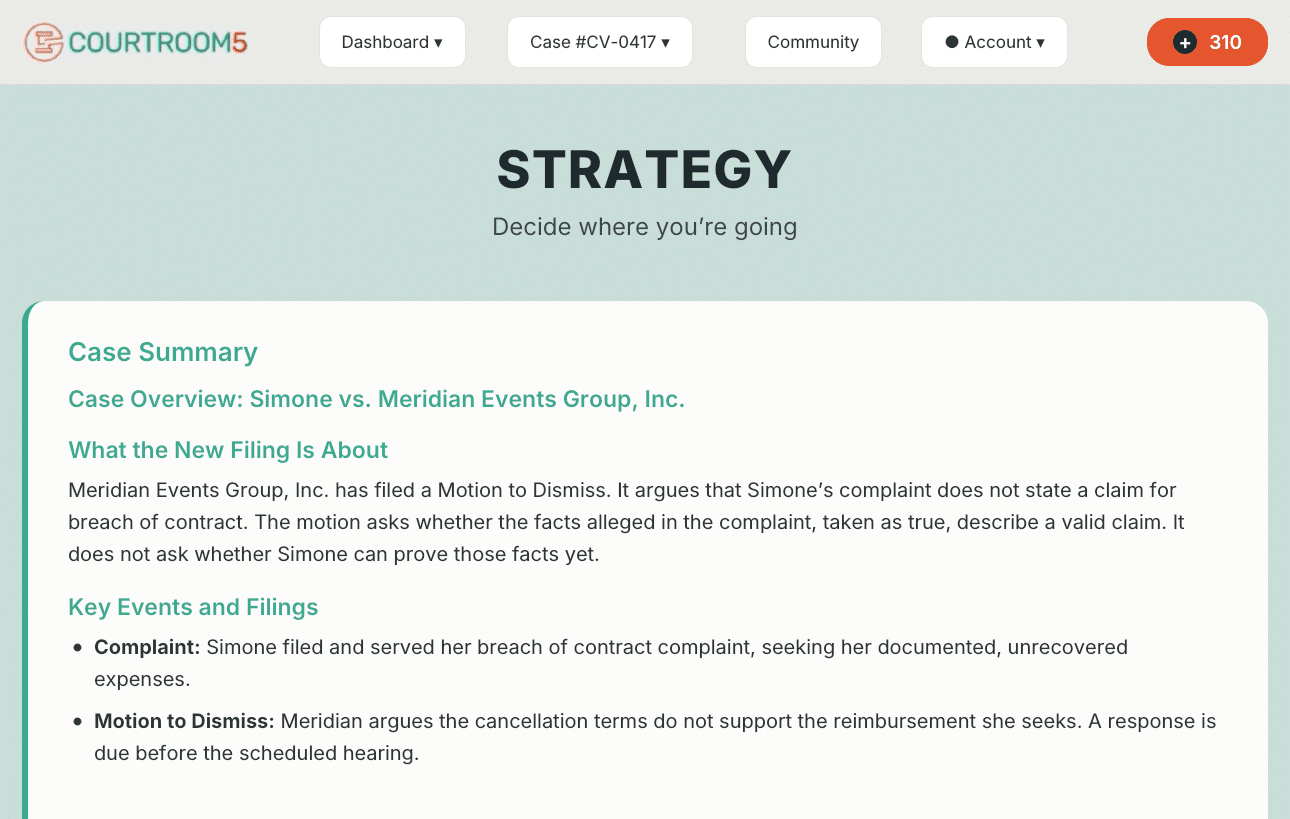
In Documents, she reviewed the rules for opposing the motion, found cases on contract cancellation and read them herself, drafted her response in her court’s format, and practiced explaining it out loud.
At the hearing, she gripped the edge of her notebook and answered the question the judge asked, not her whole story. The court denied the motion, and her case moved forward.
Got a motion, a deadline, or a contract that was broken?
See if your case qualifies →$1 gets you 100 credits and community access. Nothing renews.
Discovery: useful evidence, not a dramatic confession
Simone used Documents to prepare targeted requests about the cancellation, the agreement and how the company calculated what it owed. She also answered their requests about her expenses and her efforts to reduce her losses.
Some of their responses came back incomplete. She identified what was missing and raised it with opposing counsel first. When that didn’t resolve it, she prepared a focused request for the court’s help and practiced for the hearing. The judge granted part of it and denied the rest as too broad. She narrowed her next request to the two records that mattered most.
The records she received showed when the company decided to cancel and how it handled her reimbursement request. When another supplier issued a refund, she went back to Proof and adjusted her damages.
Settlement: a decision, not a surrender
Before trial, the company offered to settle. The first offer was low. Because her numbers were documented, she could explain them, ask for a written proposal and take time to review it.
She accepted an agreement that reimbursed most of her documented, unrecoverable expenses. She confirmed the payment arrived before completing the dismissal, and saved every closing document.
What a case like this costs on Courtroom5
You see the price of every step before you take it. Typical ranges:
- Analyzing your case and the legal issues: about 165–270 credits
- Drafting one document (such as an Answer or a Motion to Dismiss): about 225–725 credits
- Preparing for and responding to discovery: about 420–1,385 credits
Your first 100 credits are $1. After that, credits are 15¢ each, or 1,000 a month with Max for $99. Community, office hours and courses never use credits.
Plan for outside costs too. Contract cases can involve filing fees and the cost of serving the other side. Many courts offer fee waivers. Courtroom5 doesn’t cover these.
What she carried forward
Simone still wished the conference had happened. But she had made every decision from an organized record, not from fear or anger. She rewrote her own cancellation and deposit terms, closed the case folder, and went back to running her business.
She hadn’t become a lawyer. She had learned to prepare: know what she could prove, understand her options, and stand behind what she filed.
Litigate like your case matters.
Start with your next useful step
You don’t have to begin as an expert. If you’re ready to understand your case and prepare for what comes next, see whether the LAW Accelerator fits.
See if your case qualifies →5 questions. 2 minutes. $1 once. Nothing renews.
About this case study. Simone is a composite drawn from the experiences of Courtroom5 members, not a report of one person’s case. Outcomes vary. Court rules and procedures depend on your case and jurisdiction. This case study is not a promise of results.
See if we can help. Start for $1